✓ Licensed Business Broker · BK3362329 ✓ Member, IBBA & Business Brokers of Florida ✓ Based in St. Augustine · Serving All of Florida Since 2018 📞 904-789-1276

Ryan C. Winter

The Blog

Selling a Business

Guides and advice for business owners in St. Augustine, Jacksonville, and Northeast Florida who are thinking about selling. Topics include valuation, deal structure, finding buyers, and navigating the closing process.

How to Sell a Trucking or Logistics Company in Florida

Short answer: Trucking and logistics companies sell on earnings, fleet condition, driver stability, and a clean compliance record. Operating authority and safety scores follow the company, buyers finance against the equipment, and the sellers who prepare their compliance file and retain their drivers command the strongest offers.

Florida’s ports, distribution corridors, and construction boom keep freight moving year-round, and the companies that haul it are steady acquisition targets. Trucking and logistics deals have their own math though: they are asset-heavy, contract-driven, and priced as much on the balance sheet as the income statement. Sellers who understand that going in negotiate from strength.

I’m Ryan C. Winter, a business broker with Truforte Business Group. Here is how Florida trucking and logistics companies are valued and sold.

How Trucking Companies Are Valued

Most small carriers sell for 2 to 3 times seller’s discretionary earnings, but the fleet complicates the picture. A company whose trucks are owned free and clear is worth more than the same earnings with a heavily financed fleet, because the buyer inherits those payments. Expect the valuation conversation to separate:

  • The operating business: earnings, contracts, lanes, and customer relationships
  • The equipment: tractors, trailers, and rolling stock at market value, net of debt
  • The intangibles: operating authority, safety record, and driver roster

Freight brokerages and asset-light logistics companies price differently, on earnings and customer relationships, and often carry higher multiples because there is no fleet to maintain.

What Buyers Examine First

  • Your safety scores. FMCSA safety data is public, and a poor score can kill a deal before the first meeting. Insurance pricing follows safety history, and buyers model it.
  • Customer concentration. Many small carriers live on two or three shippers. If one customer is half your revenue, expect structure in the deal, an earnout or holdback tied to retention.
  • Driver roster and turnover. Staffed trucks generate revenue; empty ones burn insurance. Documented driver tenure and pay structure matter enormously.
  • Contract versus spot mix. Dedicated lanes and contracted freight carry premium value over spot-market dependence.
  • Maintenance records. A documented maintenance program is proof the fleet’s book value is real.

Florida-Specific Angles

Port drayage at Jacksonville, Tampa, and Miami, construction hauling in every growing metro, and produce and refrigerated freight moving north give Florida carriers specialty niches that buyers pay for. Intrastate operations also simplify some regulatory overhead. If your company owns its yard or terminal, that real estate is often a significant part of the deal; see my post on selling a business with real estate.

Preparing to Sell

  1. Build the fleet schedule: every unit with year, mileage, condition, and payoff amount.
  2. Clean up compliance: driver qualification files, drug and alcohol program records, and ELD data should be audit-ready.
  3. Document your lanes and rates, showing revenue per truck per week and margin by customer.
  4. Address concentration where you can by adding shippers in the year before selling.
  5. Decide the asset structure early. Whether the deal is an asset sale or stock sale matters more in trucking than most industries because of authority transfer and liability history.

The Sale Process

Trucking sales run the standard confidential course, valuation, blind marketing, screened buyers, offers, due diligence, and close, with extra attention on insurance transition and authority transfer at the end. Six to ten months is typical. The step-by-step guide covers the stages in detail.

Find Out What Your Company Is Worth

I’m Ryan C. Winter, Business Broker with Truforte Business Group, working with trucking and logistics owners across Florida. Start with the free valuation calculator or call (904) 789-1276 for a confidential, no-obligation conversation.

Authority, Safety Scores, and the Compliance File

Your operating authority, safety rating, and inspection history are all visible to a buyer before they ever call you, because federal motor carrier records are public. A clean file is a selling asset; a spotty one is a discount waiting to be negotiated. Organize driver qualification files, maintenance records, and drug and alcohol program documentation before going to market, because diligence here is not optional and lenders read the same records buyers do.

Drivers Decide Your Multiple

In this labor market, a stable driver roster is often worth more to a buyer than the trucks. Expect questions about turnover, pay structure, and how many drivers are likely to stay through a sale. If you rely on owner-operators, be ready to show the relationships are durable and properly classified, because misclassification risk is one of the first things a buyer’s attorney looks for.

The Fleet and the Balance Sheet

Asset-heavy businesses carry their own valuation nuance: the trucks and trailers have appraisable value, financing follows the collateral, and fleet age drives both maintenance cost and buyer perception. A fleet list with years, mileage, and maintenance history belongs in your first information package. The rest of the sale follows the standard Florida path: see the complete selling guide and the valuation calculator.

Frequently Asked Questions

What is a trucking company worth in Florida?

Most small carriers sell for 2 to 3 times seller’s discretionary earnings, with the fleet valued alongside at market value net of debt. Contracted freight, dedicated lanes, and clean safety scores push pricing up; spot-market dependence pulls it down.

Do my trucks transfer with the business?

That is negotiated. Owned equipment typically transfers with the sale at an agreed value, while financed units either get paid off at closing or assumed by the buyer. A current fleet schedule with payoffs is essential before listing.

Will my safety record affect the sale?

Directly. FMCSA safety data is public, buyers check it before the first conversation, and insurance pricing follows it. A clean safety profile widens your buyer pool and supports your multiple; a troubled one narrows both.

Does my operating authority transfer when I sell?

It depends on deal structure. In a stock sale the company, and its authority, changes hands intact; in an asset sale the buyer typically operates under their own or newly acquired authority. This is a structural decision to make early with your broker and attorney, because it affects timeline and customer continuity.
How to Sell a Manufacturing Business in Florida

Short answer: Florida manufacturing businesses sell on the strength of their earnings, their equipment, their workforce, and how transferable the operation is without the owner. Buyers and lenders scrutinize work in process, customer concentration, and the physical plant, so preparation in those areas is where sellers gain the most.

Manufacturing businesses are scarce and prized in Florida’s sale market. Most of the state’s economy runs on services, so when an established manufacturer comes up for sale, with real equipment, real customer contracts, and skilled people, it draws attention from individual buyers, strategics, and private equity all at once. Manufacturers also carry some of the strongest multiples of any small business category.

I’m Ryan C. Winter, a business broker with Truforte Business Group. Here is how Florida manufacturing businesses are valued and what preparation pays off most.

What Manufacturing Businesses Sell For

Small manufacturers typically sell for 3 to 4.5 times seller’s discretionary earnings, and companies with over $1 million in EBITDA and a management team routinely attract private equity at 4 to 6 times EBITDA or better. Why manufacturers price above service businesses:

  • Barriers to entry. Equipment, certifications, and process knowledge cannot be replicated by a competitor with a truck and a website.
  • Contracted, repeat B2B revenue, often with purchase orders and long-standing customer relationships.
  • Tangible asset backing. Machinery gives lenders collateral, which makes deals easier to finance at higher prices.

What Buyers Scrutinize

  • Customer concentration. The classic manufacturer risk: one OEM customer at 50 percent of revenue. Expect deal structure, an earnout or holdback, if concentration is high. My post on customer concentration and valuation covers the math.
  • Equipment condition and capacity. An appraisal-ready equipment list with age, hours, and maintenance history, plus honest capacity utilization numbers. Unused capacity is a growth story; worn-out iron is a capital expenditure the buyer will deduct.
  • Skilled labor depth. Machinists, welders, and operators are hard to hire anywhere, and Florida is no exception. Tenure and cross-training records directly support your price.
  • Certifications and approvals: ISO, AS9100, FDA registrations, or customer-specific qualifications transfer enormous value if they transfer cleanly. Know which are entity-held, because that affects asset versus stock sale structure.
  • Inventory reality. Raw materials and finished goods get counted and priced at closing; obsolete stock gets excluded. Clean it up first. Here is how inventory is handled in a sale.

Florida Angles

Florida manufacturing clusters around aerospace and defense on the Space Coast, marine industries statewide, medical devices, building products feeding the construction boom, and food production. Buyers from out of state increasingly target Florida manufacturers specifically, for the tax climate and workforce migration. If you own your industrial building, that property is a major deal component, and the own-versus-lease-back decision deserves early attention; see selling a business with real estate.

Preparing for a Premium Exit

  1. Document processes and tribal knowledge. Work instructions and training records make the operation transferable, which is what the multiple pays for.
  2. Diversify customers where possible in the two years before selling.
  3. Invest selectively in bottleneck equipment. Strategic capex that expands capacity can return several times its cost at sale.
  4. Get financials GAAP-adjacent: accrual books with clean cost of goods and inventory accounting. Larger buyers will run a quality of earnings review, and surviving it well protects your price.
  5. Build the second layer of management, because a plant that runs without you is the whole thesis.

The Process

Manufacturing sales run six to twelve months through the confidential standard: valuation, targeted blind marketing, NDA-screened buyers, offers, due diligence, and close. With multiple buyer types in play, running a competitive process matters more here than almost anywhere. The step-by-step guide covers each stage.

What Is Your Company Worth?

I’m Ryan C. Winter, Business Broker with Truforte Business Group, working with manufacturers across Florida. Start with the free valuation calculator or call (904) 789-1276 for a confidential, no-obligation conversation.

The Numbers Buyers Actually Trust

Manufacturing buyers tend to think in EBITDA terms sooner than buyers of other Main Street businesses, because many acquirers plan to install or keep a manager rather than run the floor themselves. That raises the bar on your financials: work in process, backlog, and inventory need to be documented, not estimated, and job costing that reconciles to your statements builds the confidence that premium offers are made of. On larger deals, expect a quality of earnings review, and welcome it, because verified numbers close.

Equipment, the Plant, and the Environmental File

Your equipment list is part of the price, so keep it current with ages, maintenance records, and any liens. Deferred maintenance reads as a hidden price cut, and buyers will find it. If real estate is part of the sale, environmental due diligence comes with it, and a clean file, permits, storage, disposal records, speeds every later stage. The purchase price allocation across equipment, inventory, and goodwill on IRS Form 8594 also lands differently for manufacturers than service businesses, so involve your CPA early.

The Workforce Is the Asset Nobody Prices

Skilled machinists, fabricators, and supervisors are hard to replace, and every buyer knows it. A stable crew that stays through the transition materially raises what your business is worth, while an operation that depends on one irreplaceable person, including you, compresses it. Cross-training and documented processes are value creation, not overhead.

Manufacturing sales follow the same path as any Florida business sale, valuation, confidential marketing, diligence, closing. See the complete selling guide, or if you are on the other side, how to buy a business in Florida. Start with the free valuation calculator to see where you stand.

Frequently Asked Questions

What is a manufacturing business worth in Florida?

Small manufacturers typically sell for 3 to 4.5 times seller’s discretionary earnings, and companies with over $1 million in EBITDA and management depth attract private equity at 4 to 6 times EBITDA or better.

Does customer concentration really matter that much?

It is the single biggest discount factor in manufacturing deals. One customer above 30 to 40 percent of revenue usually means deal structure: an earnout, holdback, or price adjustment tied to retention. Diversifying in the two years before selling pays for itself many times over.

Do my certifications transfer to a buyer?

It depends on how they are held. ISO and similar certifications tied to the entity often survive a stock sale but need requalification work in an asset sale, and customer-specific approvals vary. This is a core reason deal structure gets decided early in manufacturing sales.

Do I need an equipment appraisal before selling my manufacturing business?

Often, yes, especially when lenders are involved, because financed deals need supportable collateral values. An appraisal also protects you from underpricing machinery that has held its value better than its depreciation schedule suggests.

How to Sell an E-commerce Business in Florida

Short answer: E-commerce businesses sell on verifiable earnings and transferability: whether the store, its platform accounts, supplier relationships, and traffic actually move to a new owner intact. Buyers come from across the country, diligence happens in the analytics, and clean data is what gets premium offers.

Florida has become one of the biggest home bases for e-commerce entrepreneurs in the country, and when those owners are ready to exit, they discover something pleasant: online businesses sell into a national buyer pool. Your buyer does not need to live near your warehouse, and often there is no warehouse at all. That widens demand, but it also means your business gets compared against every other listing in the country, so presentation and verifiable numbers decide everything.

I’m Ryan C. Winter, a business broker with Truforte Business Group. Here is how e-commerce businesses are valued and sold.

What E-commerce Businesses Sell For

Most e-commerce businesses sell for 2.5 to 4 times seller’s discretionary earnings, with the multiple driven by durability more than growth:

  • Channel mix. A business that owns its customer relationship, its own Shopify store, email list, and repeat buyers, prices above one that depends entirely on a single Amazon account that could be suspended tomorrow.
  • Brand and moat: registered trademarks, proprietary products, and reviews accumulated over years beat resellable generic goods.
  • Supplier stability: documented relationships, backup suppliers, and reasonable payment terms that transfer.
  • Repeat purchase rate and subscription revenue, the e-commerce version of recurring revenue, command clear premiums.
  • Owner hours. A business running on ten hours a week with a VA team is worth more per dollar of profit than a seventy-hour grind.

What Buyers Verify

E-commerce due diligence is data diligence. Buyers will want screen-share access to verify, not just spreadsheets: sales dashboards, ad accounts, analytics, and payment processor records that reconcile to your books and tax returns. They will study cost of goods accuracy including freight and tariffs, true advertising cost per order, return rates, and inventory position. Anything that cannot be verified gets valued at zero. If your personal and business finances are tangled, spend a few months cleaning up the books before listing.

Deal Structure Quirks

  • Inventory is priced on top of the business price at landed cost, with stale stock excluded; see how inventory is handled.
  • Account transfers need care: marketplace accounts, payment processors, and ad accounts each have their own transfer rules, and the migration plan belongs in the purchase agreement.
  • Training and transition are shorter than in offline businesses, often 30 to 90 days of support, sometimes with a consulting tail.
  • SBA financing works for e-commerce with solid tax returns, which opens your buyer pool beyond cash buyers, and my post on how SBA loans affect a sale explains the lender’s view.

Why Use a Broker for an Online Business

Online sellers get approached constantly by aggregators and direct buyers, and unrepresented sellers routinely accept the first offer, which is rarely the best one. A confidential, competitive process, where the business is packaged properly and multiple qualified buyers bid, is how sellers find the real market price. That is the same discipline I bring to every Florida deal, and it applies whether your business ships from a 3PL in Ohio or your garage in Jacksonville. My guide on selling a home-based or online business is a good companion read.

Find Out What Your Store Is Worth

I’m Ryan C. Winter, Business Broker with Truforte Business Group, working with e-commerce owners across Florida. Start with the free valuation calculator or call (904) 789-1276 for a confidential, no-obligation conversation.

Transferability Decides the Deal

The first question a sophisticated buyer asks is not about revenue, it is about what actually transfers. Marketplace accounts, storefronts, payment processors, supplier agreements, and ad accounts each have their own transfer rules, and a store built on accounts that cannot move has a problem no multiple can fix. Map this before you list: what is in the business’s name versus your personal name, and what each platform’s policies allow.

Verification Happens in the Analytics

Online businesses are unusually verifiable, and buyers use that. Expect to grant read-only access to your analytics, seller dashboards, and payment processors so reported revenue can be matched to deposits. Two dependencies get special scrutiny: traffic concentration, where one channel or one ad account drives most sales, and supplier concentration, where one vendor could end the business. Diversification you build now is negotiating power later.

Your Buyer Is Probably Not Local

E-commerce deals draw buyers nationwide, and closings happen remotely as a matter of routine. That widens your buyer pool dramatically, and it makes confidential, well-run process management matter more, not less, because you may never sit across a table from the person buying your store. The fundamentals still apply: see the complete guide to selling a business in Florida and run your numbers with the free valuation calculator.

Frequently Asked Questions

What is an e-commerce business worth?

Most e-commerce businesses sell for 2.5 to 4 times seller’s discretionary earnings. Owned customer relationships, trademarks, repeat purchase rates, and low owner hours push the multiple up; single-channel dependence pulls it down.

Can I sell an Amazon FBA business?

Yes, FBA businesses sell constantly, though buyers price the platform risk of a single marketplace account. Diversified channels, a registered brand, and strong review equity all improve both price and buyer confidence.

Do I need a broker to sell my online business?

Sellers approached directly by aggregators routinely accept below-market offers because nothing forced competition. A confidential process that packages the business properly and puts multiple qualified buyers in play is how the real market price gets discovered.

Can I sell an e-commerce business that runs from my house?

Yes. Location matters far less than earnings, transferability, and documentation. Home-based and laptop-run businesses sell regularly; what buyers care about is whether the operation works the same way after you hand it over.

How to Sell a Business in Florida: The Complete 2026 Owner’s Guide

Short answer: To sell a business in Florida, you establish a defensible valuation based on your earnings, clean up your financials, market the business confidentially to qualified buyers, negotiate a letter of intent, complete due diligence, and close. Timelines vary widely. A well prepared business with a well qualified buyer can close in as little as two months, while other sales run six to twelve months or longer.

I am Ryan C. Winter, a licensed Florida business broker with Truforte Business Group, based in St. Augustine and working with owners throughout Florida. This guide walks through how a Florida business sale actually happens, what it costs, how long it takes, and where deals fall apart. It is written for owners of privately held businesses, which is where most of my work sits.

What Selling a Business in Florida Actually Involves

Selling a business is not one transaction. It is a sequence of stages, and each one can stall. Owners tend to underestimate the first stage and overestimate the last one. Preparation is where the money is made. Closing is mostly paperwork.

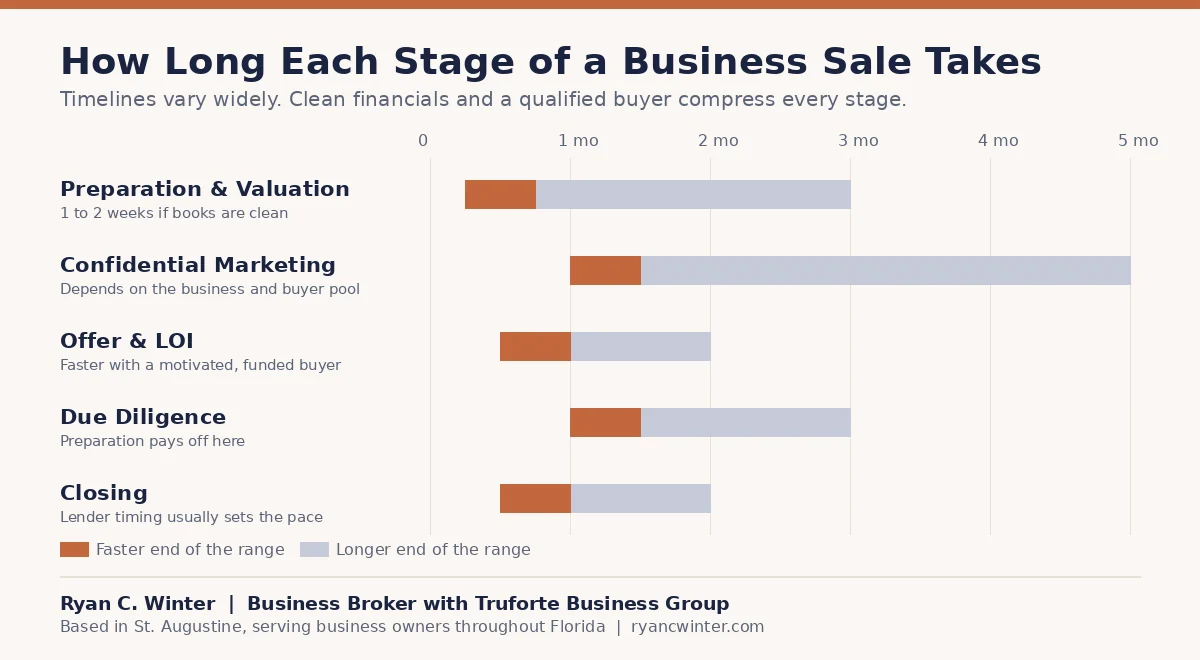
The honest answer on timing is that it depends on you. If your financials have been well maintained, preparation and valuation can take a week or two rather than months, and a well prepared business in front of a well qualified buyer can move to closing in about two months. If the books need work, or the business leans heavily on you personally, the same sale can take a year.

Chart showing how long each stage of a Florida business sale takes, with faster and longer ends of each range
How long each stage tends to run. The faster end of every range belongs to sellers who prepared before going to market.

Step 1: Find Out What Your Business Is Actually Worth

Smaller, owner operated businesses are usually valued on a multiple of seller’s discretionary earnings, or SDE. SDE is your net profit plus the owner’s salary, plus interest, taxes, depreciation and amortization, plus any personal or one time expenses running through the business. Larger businesses, where a buyer expects to hire a manager rather than step into your shoes, are more often valued on EBITDA. There is no bright line between the two. It depends on the size of the business, how it is structured, and who the likely buyer is.

The multiple applied to that number is where owners are most often surprised. Multiples vary considerably by industry, size, growth, and risk. Two businesses with identical earnings can be worth meaningfully different amounts. What moves the number is risk, not revenue, which is why rules of thumb are a poor substitute for understanding what a buyer is actually pricing.

What tends to raise your value

  • Recurring or contracted revenue rather than one off jobs
  • A team that runs the business without you in it every day
  • Clean financials that reconcile to your tax returns
  • A diversified customer base, where no single client represents an outsized share of revenue
  • A transferable lease, licenses, and supplier relationships

What tends to lower it

  • The business depends on you personally for sales or delivery
  • Customer concentration, where losing one account would gut the business
  • Cash sales that cannot be substantiated on the books
  • Declining revenue over the trailing twelve months
  • Deferred maintenance, aging equipment, or a lease about to expire

You can get a starting number in a few minutes with my free business valuation calculator. It is not a substitute for a broker opinion of value, but it will tell you whether your expectations are in the right neighborhood before you spend a year on this.

Step 2: Clean Up Your Financials Before Anyone Asks

This is the highest return work you will do, and it is the stage that most affects your timeline. Buyers and their lenders will not take your word for anything. If your books do not reconcile to your tax returns, the deal either dies or reprices, and it usually reprices downward.

Practical steps: get three years of clean profit and loss statements and balance sheets. Separate personal expenses out of the business and document every add back you intend to claim. Reconcile your accounts monthly. If you are running personal vehicles, family phones, or a boat through the company, that is common in a small business, but every add back needs a receipt behind it.

Owners often ask whether a formal quality of earnings report is worth paying for. It depends on the size and complexity of the deal and on who the buyer is. On larger or more complex transactions it can pay for itself by removing the buyer’s excuse to renegotiate. On smaller, simpler deals, well organized statements and tax returns are frequently enough. It is a question worth asking early rather than in the middle of due diligence.

Step 3: Market the Business Without Destroying It

Confidentiality is not paranoia. If your employees learn the business is for sale, your best people start looking. If your competitors learn, they call your customers. If your customers learn, they hedge. A leak can cost you more than the broker fee.

The mechanics: the business is marketed under a blind profile that describes the operation and the market without naming it. Buyers sign a non-disclosure agreement and are qualified financially before they see anything identifying. Only then do they receive the confidential information memorandum with the real numbers.

In Florida, Main Street listings are commonly marketed through the Business Brokers of Florida network alongside the national marketplaces. That combination is how you reach both in state buyers and the out of state buyers who move to Florida specifically to buy a business.

Owners also worry about staff. What happens to your employees is worth planning deliberately rather than improvising on closing day.

Step 4: Buyers, Offers, and How Florida Deals Get Financed

Many Florida small business sales are financed with an SBA 7(a) loan. That matters more than owners expect, because it means the lender, not just the buyer, has to believe your numbers. SBA underwriting shapes the structure of the whole deal: the business has to cash flow the debt after paying the new owner a living wage.

Buyers using SBA financing are typically expected to put down around 10 percent of the purchase price. Seller financing is common in these deals and can help bridge the gap between what a buyer can fund and what you want at closing. Owners often resist carrying paper. In practice, a seller note is frequently what makes the price you wanted achievable, and it signals to the buyer that you believe the business will keep performing after you leave.

Offers arrive as a letter of intent. An LOI is mostly non binding on price but binding on exclusivity, which means the moment you sign it you have taken the business off the market for that buyer. Do not sign one casually.

Step 5: Due Diligence and Closing

Due diligence is where prepared sellers get rewarded and unprepared sellers get repriced. The buyer verifies everything you claimed: financials, contracts, leases, licenses, equipment, litigation, and employees. This is the clearest example of preparation paying off. Sellers who did the work in Step 2 move through it quickly.

Two Florida specifics worth knowing. Small business sales here are commonly structured as asset sales rather than stock sales, which protects the buyer from historical liabilities and changes your tax treatment. The purchase price gets allocated across asset classes on IRS Form 8594, and both sides must report the same allocation. That allocation is negotiable and there is real money in it, so involve your CPA before you agree to it, not after.

Second, Florida has no state personal income tax. Your gain is still subject to federal capital gains tax, but you are not paying a state layer on top the way a seller in New York or California would. If you are spreading payments over years, the installment sale rules in IRS Publication 537 govern how that income is recognized.

What It Costs to Sell a Business in Florida

Broker commissions on Main Street Florida deals typically run 10 to 15 percent of the sale price, paid at closing out of proceeds. Larger or more complex transactions generally move to a Lehman scale, a tiered structure where the percentage steps down as the price rises. You will also pay your own CPA and attorney, and those are worth every dollar. I break the full picture down in what a business broker charges in Florida.

One thing worth knowing about Florida specifically: business brokers here are regulated under Chapter 475 of the Florida Statutes and must hold a real estate license issued by the Florida Department of Business and Professional Regulation. If someone offers to broker your business without one, that is a problem. You can verify any license on the DBPR website in about a minute, including mine.

Do You Actually Need a Broker?

Honestly, not always. If you already have a buyer, know your number, and have a good transaction attorney, you may not need me. Owners who sell to a family member, a partner, or a key employee often do fine without a broker, and I will tell you that on the phone rather than after you sign a listing agreement.

Where a broker earns the fee is in reach, confidentiality, buyer qualification, and keeping the deal alive through due diligence. Sales that fall apart usually do so after the LOI, and they fall apart for emotional and procedural reasons more often than financial ones. That is most of what a broker actually does.

Selling Guides by Industry

Every industry sells a little differently, in what buyers verify, how the business is priced, and which licenses or leases have to transfer. These guides go deeper on the specifics.

Statewide Industry Guides

St. Augustine and Northeast Florida

Frequently Asked Questions

How long does it take to sell a business in Florida?

It varies more than owners expect, and preparation is the biggest factor. A well prepared business with clean financials and a well qualified buyer can close in as little as about two months. Many sales run six to twelve months. If your books are already well maintained, preparation and valuation can take a week or two rather than months, which compresses everything downstream.

What is my Florida business worth?

It depends on your earnings and, more importantly, on risk. Smaller owner operated businesses are usually priced on a multiple of seller’s discretionary earnings, while larger ones are more often priced on EBITDA. Multiples vary by industry, size, growth, and how dependent the business is on the owner. The free valuation calculator gives a starting estimate, and a broker opinion of value will refine it.

Do I have to pay Florida state tax when I sell my business?

Florida has no state personal income tax, so there is no state level tax on your gain. You will still owe federal capital gains tax, and how the purchase price is allocated across asset classes on IRS Form 8594 materially affects what you pay. Talk to your CPA before agreeing to an allocation.

How much do I need to put down to buy a business with an SBA loan?

Buyers using SBA 7(a) financing are typically expected to put down around 10 percent of the purchase price. Seller financing is common alongside it and can help bridge the gap between what the buyer can fund and what the seller wants at closing.

Will my employees find out I am selling?

Not if the sale is run properly. The business is marketed under a blind profile, buyers sign an NDA and are financially qualified before receiving identifying information, and staff are typically told at or near closing as part of a planned transition.

Do Florida business brokers need a license?

Yes. Business brokers in Florida are regulated under Chapter 475 of the Florida Statutes and must hold a real estate license issued by the Florida Department of Business and Professional Regulation. You can verify any broker’s license on the DBPR website.

Can I sell my business myself without a broker?

Yes, and it often makes sense when you already have a buyer, such as a family member, partner, or key employee. Without an identified buyer, the hard parts are reaching qualified buyers confidentially and holding the deal together through due diligence, which is where unrepresented sales most often fail.

Where to Start

If you are a year or more from selling, start with preparation. Clean the books, reduce how much the business depends on you, and lock down your lease. If you are closer than that, start with a valuation so you know whether your number is realistic.

You can work through the whole process in my complete seller’s guide, run your numbers with the valuation calculator, or reach out directly for a confidential conversation. I am based in St. Augustine and work with owners across Florida, and there is no cost to talk it through.

Sitting on the other side of the table? See how to buy a business in Florida.

Prefer video? You can watch the full walkthrough of how a business sale works.

Business Broker for Ponte Vedra & Nocatee, FL

The Ponte Vedra and Nocatee corridor is the wealthiest stretch of Northeast Florida and one of the fastest-growing communities in the entire country. For business owners here, that combination creates something valuable: customer bases with premium spending power and a buyer pool that understands exactly what those customers are worth.

I’m Ryan C. Winter, a licensed business broker with Truforte Business Group, based right here in St. Johns County. This corridor is my home market in the most literal sense, and I represent owners here with Truforte’s statewide platform and the 900-broker BBF network behind every listing.

What Makes This Corridor Different for Sellers

  • Premium recurring clientele. Pool routes, lawn and landscape accounts, home watch, cleaning, and wellness businesses serving Ponte Vedra and Nocatee households carry rate cards and retention that buyers pay a premium to acquire.
  • Growth buyers can underwrite. Nocatee has spent years among the best-selling master-planned communities in America, and a service business positioned in its path lets a buyer purchase next year’s customers, not just last year’s.
  • An affluent buyer pool close by. Executives and professionals in these zip codes increasingly buy businesses instead of starting them, often SBA-financed and well advised.

What Ponte Vedra Area Businesses Sell For

The Florida fundamentals hold: 2 to 3.5 times seller’s discretionary earnings for most main street businesses, with the corridor’s premium client bases and growth story pushing well-run companies toward the top of the range. Documented rates, low churn, and staff who stay matter more here than anywhere, because that is precisely what the buyer is paying up for. Start with the free calculator, or my guide to Florida valuation for the mechanics.

Confidentiality in a Connected Community

Ponte Vedra runs on the same social fabric as its country clubs: tight, talkative, and small. Sales here are blind by default in my practice, with NDAs and financial screening before any buyer learns which business is on the market, and showings arranged away from curious eyes. The full process is in my St. Johns County confidentiality guide.

Frequently Asked Questions

Do I need a Ponte Vedra business broker specifically?

You need a broker who knows St. Johns County firsthand and can reach buyers far beyond it. I am based in the county and work this corridor directly; the honest alternatives are the Jacksonville brokers I compare in my guide to the best brokers in St. Augustine and St. Johns County.

What kinds of Nocatee area businesses are buyers looking for?

Recurring home services above all: pool, lawn, pest, cleaning, and maintenance books serving the new rooftops, plus medical, dental, childcare, and food businesses positioned in the growth path. If your business serves these households and your books are clean, buyer demand is genuinely strong right now.

Your Neighbor, and Your Broker

If you own a business serving Ponte Vedra, Nocatee, or the greater St. Johns corridor, the first step is a quiet conversation and an honest number, from a broker who lives in this market. Call (904) 789-1276 or start with the free valuation calculator.

Business Broker for Amelia Island & Fernandina Beach, FL (Nassau County)

Amelia Island and Fernandina Beach sit in one of the most interesting small business markets in Florida: a genuine tourism economy anchored by the island’s resorts and historic downtown, a fast-growing Nassau County population on the mainland side, and a business community small enough that everyone knows everyone. That last part is exactly why selling a business here requires more care than almost anywhere in Northeast Florida.

I’m Ryan C. Winter, a licensed business broker with Truforte Business Group. I am based in St. Augustine and work with owners across Northeast Florida, including Nassau County, backed by Truforte’s statewide platform and the BBF network of more than 900 cooperating brokers.

What Sells in Nassau County

  • Tourism and hospitality: restaurants, tours and charters, retail in historic Fernandina, and everything serving the island’s resort traffic. Buyers want to see seasonality documented, not explained away.
  • Home services: Yulee and the 200 corridor are among the fastest-growing suburbs in the region, and the pool, lawn, HVAC, and repair companies serving those rooftops attract the same consolidator and SBA-buyer demand seen across Florida.
  • Marine businesses, from service to charters, with the same license and dockage questions I cover in my marine business guide.

Pricing an Amelia Island Business

The mechanics match the rest of Florida: most main street businesses trade on a multiple of seller’s discretionary earnings, typically 2 to 3.5 times, with recurring revenue at the top of the band. The island adds two local wrinkles: premium leases and locations carry real transferable value in the historic district, and tourism revenue earns full price only when the books prove it across seasons. A free valuation tells you where your business sits before you make any decisions.

Selling Quietly in a Small Town

Fernandina is a small town in the best and hardest sense. Word moves fast, staff and customers overlap socially, and a rumor can do real damage before a deal exists. Every sale I run here is blind: no name, no address, buyers screened and under NDA before they learn which business is for sale, exactly as described in my guide to confidential sales in Florida. Meanwhile the listing works statewide through the BBF MLS and nationally through BizBuySell, because the right buyer for an island business is often not on the island.

Frequently Asked Questions

Is there a business broker on Amelia Island?

Nassau County has no deep bench of resident brokers, and most island businesses sell through Northeast Florida brokers who cover the county, including me from St. Augustine and the Jacksonville offices up the road. What matters is regional market knowledge, BBF reach, and a confidentiality process built for a small town.

What is my Fernandina Beach business worth?

Most established businesses here sell for 2 to 3.5 times discretionary earnings, with documented year-round revenue, premium locations, and staff stability pushing toward the top. The free calculator gives a starting range in three minutes.

Talk to a Broker Who Works Nassau County

If you own a business on Amelia Island, in Fernandina Beach, or along the growing 200 corridor, start with a confidential conversation and an honest number. Call (904) 789-1276 or use the free valuation calculator.

How to Find the Right Business Broker in Jacksonville, FL

Jacksonville has more business brokers than any market in Northeast Florida, which makes finding one easy and finding the right one genuinely hard. The difference is worth real money: the right broker prices your business on evidence, keeps the sale quiet, and carries the deal through due diligence; the wrong one collects your listing and waits.

I’m Ryan C. Winter, a licensed business broker with Truforte Business Group, based in St. Augustine and working across Jacksonville and Northeast Florida. Obvious disclosure: I am one of the brokers you might find through this process. Here is the process anyway, honestly.

Step 1: Build a Shortlist From Real Sources

Skip the ads and go where the verifiable information lives: the Business Brokers of Florida member directory, the IBBA directory for credentialed brokers, BizBuySell broker profiles showing actual listings, and referrals from your CPA or attorney, who see brokers’ work product after the marketing is over. I have also published an honest comparison of the best business brokers in Jacksonville, including my competitors, which is a reasonable starting shortlist.

Step 2: Verify Before You Call

  • License: Florida business brokers operate under real estate licensure; check the DBPR portal for an active license and clean history.
  • BBF membership, which puts your listing in front of 900+ cooperating Florida brokers rather than one office’s buyer list.
  • Actual closed deals in your size range and, ideally, your industry.
  • The individual, not the brand. Jacksonville’s franchise offices contain both excellent and inexperienced agents; you are hiring the person who carries your file.

Step 3: Interview at Least Two, and Ask the Hard Questions

Interview brokers the way buyers will interview your business. How many listings do you personally carry? What were your last five closed deals? Show me the math behind your valuation. What, specifically, happens in the first thirty days of marketing? How do you keep a Jacksonville sale confidential when half this town knows each other? My list of ten questions to ask before hiring a broker works word for word in Jacksonville, and my honest piece on the problems with business brokers tells you which answers should end an interview.

Step 4: Beware the Highest Number in the Room

The most common trap in broker selection: hiring whoever quotes the biggest valuation. Overpricing is how listings go stale, and some brokers quote high precisely because it wins signatures. Hire the broker whose number survives questioning, not the one whose number flatters you. If the valuations you collect differ wildly, that spread is itself information; my guide to setting the right asking price explains what a defensible number looks like.

Step 5: Read the Listing Agreement Before You Sign

Term length, fee structure, what happens if you find the buyer yourself, and what marketing is actually promised: get it in writing and have your attorney glance at it. Standard in Florida is a success fee at closing, typically 10 to 15 percent for main street businesses, with no significant upfront charges. Anything else deserves questions.

Frequently Asked Questions

How do I find a business broker in Jacksonville?

Shortlist through the BBF and IBBA directories, BizBuySell profiles, CPA and attorney referrals, and published comparisons; verify licenses on DBPR; then interview at least two brokers and hire the individual whose process and pricing logic hold up, not the biggest brand or the biggest number.

Should my Jacksonville broker be local?

Your broker should know the Northeast Florida market and buyer pool firsthand, whether their office is in Jacksonville proper or, like mine, just down the road in St. Augustine. What matters more than the office address is BBF reach, personal attention, and closed-deal experience in your size range.

Start the Conversation

Interview me alongside anyone on your shortlist: free valuation with the math shown, fees in writing, nothing upfront. Call (904) 789-1276 or start with the free valuation calculator.

You can also see my Jacksonville business broker services.

If you are widening the search beyond Jacksonville, my statewide review of the best business brokers in Florida covers the firms every Florida seller should know.

What Is the BBF MLS? How Florida’s Business Broker Network Actually Works

Short answer: The BBF MLS is a members-only multiple listing service run by Business Brokers of Florida, one of the largest state business broker associations in the country. When a member broker lists your business, every other member broker in Florida can see it and bring buyers, which is reach a public listing site alone cannot match.

Florida has something almost no other state has: a true multiple listing service for businesses, run by Business Brokers of Florida. Sellers benefit from it enormously and almost never know it exists, because the system is visible only to member brokers. This is the plain-English explanation.

I’m Ryan C. Winter, a licensed business broker with Truforte Business Group in St. Augustine, and yes, I am a participant in the system I am describing, so read with that in mind.

What BBF Is

Business Brokers of Florida is a nonprofit association of the state’s business brokerage community, and the largest state business broker association in the country, with more than 900 members. Its members collectively closed over $900 million in Florida business sales in 2025, the second straight year approaching a billion dollars. At its center sits the Business Listing Service, the BBF MLS: a statewide database where member brokers share their listings with each other, just as residential agents share homes on the real estate MLS.

The Rule That Makes It Work: Mandatory Cooperation

The association’s rules require member offices to cooperate on listings, meaning any member broker can bring their buyer to any other member’s listing and share the commission. In practice, when a business lists with one BBF broker, several hundred other brokers and their buyer pools are effectively working the same listing. For sellers, that is the whole point: you hire one broker and get a statewide sales force.

What It Means for Sellers

  • Reach without exposure. BBF listings are blind to the public and detailed to member brokers, which is how a business gets marketed statewide while staying confidential.
  • Real comparable data. Sold-business data inside the system is how Florida brokers price listings on evidence rather than folklore, which is what a defensible valuation is built from.
  • A screened buyer channel. Buyers arriving through a cooperating broker are typically NDA-signed and pre-qualified before you ever hear about them.

What It Means for Buyers

Only member brokers can search the full system, so buyers working with a BBF broker see inventory, including fresh listings, that never surfaces the same way on public marketplaces. If you are buying in Florida, registering with a member broker costs nothing and widens your view; you can search listings and register as a buyer here.

The Honest Limits

The BBF MLS is infrastructure, not magic. It cannot fix an overpriced listing, it does not replace national marketplace exposure, which is why listings should also syndicate to BizBuySell and the public platforms, and its value depends entirely on the broker using it well. It is also member-only by design, which means the one way to access it is the one honest catch: you need a member broker.

Why Co-Brokerage Is the Part That Matters

The mechanism that makes the BBF MLS valuable is co-brokerage: the listing broker and a buyer’s broker cooperate on the same deal and share the commission. That means hundreds of brokers across Florida have a direct financial incentive to bring their buyers to your listing. On a public listing site, you are waiting for a buyer to find you. On the MLS, an entire profession is motivated to match you.

It also solves the confidentiality problem. Your listing circulates among licensed, NDA-disciplined professionals rather than sitting in public view, which is how a business gets broad exposure without employees, competitors, and customers finding out. See where to list a business for sale in Florida for how the MLS compares with the public marketplaces, and how to sell a business in Florida for where listing fits in the whole process.

Frequently Asked Questions

Can I search the BBF MLS myself?

The full system is member-only, though public-facing listing summaries appear on the association’s site and syndicate to marketplaces. Buyers get full access by working with any member broker, at no cost to the buyer.

Is my broker a BBF member?

Ask, and verify in the BBF member directory. In Florida, membership is close to table stakes for a serious business broker; I would want a very good explanation from any broker who is not a member. I am, through Truforte Business Group.

Put the Network to Work

Whether you are selling confidentially or buying seriously, the BBF system is the quiet advantage in every well-run Florida deal. Call (904) 789-1276 or start with the free valuation calculator.

The BBF MLS is one piece of marketing your business. See how to sell a business in Florida.

Most of the firms in my review of the best business brokers in Florida co-broker through this same network.

What Does a Business Broker Actually Do? A Deal-by-Deal Breakdown

Most owners hire a business broker exactly once in their lives, which means most owners sign a listing agreement without really knowing what the fee buys. So here is the honest, stage-by-stage answer to what a business broker actually does, written by one, including the parts of the job that are invisible when they are done well.

I’m Ryan C. Winter, a licensed business broker with Truforte Business Group, based in St. Augustine and working across Florida. A broker is a licensed intermediary who manages the sale of a business from valuation through closing; in Florida, that work happens under a real estate license and, for most of us, inside the Business Brokers of Florida cooperative. That is the definition. What follows is the job.

Stage 1: Pricing the Business Honestly

The work starts with a broker’s opinion of value: normalizing your financials into seller’s discretionary earnings, identifying legitimate add-backs, and applying multiples from comparable sold businesses. This stage decides the whole engagement. A broker who prices on evidence sets up a sale; a broker who prices on flattery sets up a stale listing, which is the first of the industry problems I have written about honestly.

Stage 2: Packaging and Confidential Marketing

Next the broker builds the marketing package: a blind listing that attracts buyers without identifying the business, and a confidential information memorandum that answers a serious buyer’s first fifty questions. The listing then goes wide: the BBF MLS where Florida’s cooperating brokers shop, BizBuySell and the national marketplaces, and the broker’s own buyer database. Done right, your employees, customers, and competitors never know the business is for sale.

Stage 3: Screening Buyers So You Never Meet the Tourists

For every buyer who eventually closes, a listing attracts dozens of the merely curious. The broker’s filter, NDAs signed, financial capability verified, motivation tested, is the least visible and most valuable daily work in the job. You keep running your business while the broker burns the hours separating three real buyers from thirty dreamers.

Stage 4: Negotiation and Deal Structure

When offers come, the broker manages the negotiation: price, terms, seller financing, transition expectations, and the difference between a clean offer and one loaded with contingencies. A good broker creates the conditions for competing offers, which is where sellers win, and tells you honestly when an offer that looks smaller is actually better.

Stage 5: Holding the Deal Together Through Due Diligence

This is where sales die, and where the fee is truly earned. The broker coordinates due diligence, keeps document requests moving, manages the buyer’s lender, solves the lease assignment, and talks both sides off the ledge during the inevitable scare. Deals do not close themselves; they are carried across the line.

Stage 6: Closing and Transition

Finally the broker coordinates the closing attorney, licenses, final walk-through, and the closing day mechanics, then helps structure the transition period where you hand the keys and the knowledge to the new owner.

What a Broker Does Not Do

Honesty requires the other list. A broker is not your attorney and should not draft your legal protections; not your CPA and should not plan your taxes; and cannot sell an unprepared business at a prepared price. You still need your own deal team, and any broker who discourages that is waving a red flag.

Frequently Asked Questions

What does a business broker charge?

Success fees at closing, typically 10 to 15 percent for Florida main street businesses; my standard is 12 to 15 percent with the Lehman scale on larger deals and nothing upfront. Full breakdown in Florida broker fees and the complete cost of selling.

Do I need a business broker to sell my business?

Not always, and I have written honestly about when selling without a broker makes sense. For most established businesses, confidential marketing, buyer screening, and deal management return more than the fee costs, but that is a case-by-case answer, not a slogan.

Meet the Job in Person

The best way to understand what a broker does is a working conversation about your business: what it is worth, what would improve the number, and what a sale would actually look like. That conversation is free and confidential. Call (904) 789-1276 or start with the free valuation calculator.

Prefer video? You can watch how a business sale actually works, start to finish.

Once you know what a broker actually does, the next question is who does it well. I wrote an inside-the-industry review of Florida’s best business brokers to answer exactly that.

Florida Business Sales Market Report (2026): What Businesses Are Actually Selling For

Business owners ask me the same question in different costumes: what are businesses like mine actually selling for right now? Most of the answers online are either national averages with no Florida context or broker marketing with no numbers at all. This report is my attempt to fix that: the current data on Florida business sales, what it means for Northeast Florida owners specifically, and what I am seeing on the ground in deals. I will update it as new data is released.

I’m Ryan C. Winter, a licensed business broker with Truforte Business Group, based in St. Augustine and working with owners across Florida. Figures below come from published industry sources, principally the BizBuySell Insight Report and Business Brokers of Florida, and I flag my own observations as exactly that.

The Headline Numbers

  • Florida brokers closed over $900 million in business sales in 2025, per Business Brokers of Florida, up about 5 percent from 2024 and the second consecutive year approaching a billion dollars in statewide deal volume.
  • The national median sale price is holding around $350,000, per BizBuySell’s most recent quarterly Insight Report, roughly flat year over year.
  • The businesses themselves are healthier: median cash flow of sold businesses grew about 3 percent to roughly $165,000, and median revenue rose to about $713,000.
  • Broker sentiment is bullish: in the same report, nearly two thirds of surveyed brokers expect deal volume to increase over the next six months.

What the Numbers Mean in Plain English

Three storylines sit inside that data. First, quality is being rewarded and weakness is being discounted: the reports describe intense buyer competition pushing multiples up for strong, well-documented businesses while softer demand meets leveraged or messy ones. The gap between a prepared business and an unprepared one has rarely priced wider. Second, flat median prices with rising cash flow means buyers are paying the same money for more earnings, which is the market quietly demanding proof. Third, Florida keeps punching above its weight: a state broker association closing nearly a billion dollars a year through its cooperative BBF listing system reflects buyer migration the rest of the country does not enjoy.

The Northeast Florida View

What I see in Jacksonville, St. Augustine, and the surrounding counties tracks the state data with local color. Buyer inquiries in Northeast Florida skew heavily toward home services, healthcare-adjacent businesses, and anything with contract or recurring revenue, and SBA-financed individual buyers remain the dominant buyer type for main street deals, which makes clean tax returns the price of admission. St. Johns County’s population growth keeps pulling in relocating buyers with real capital, and the businesses that struggle to sell here are the same ones that struggle everywhere: owner-dependent operations with informal books. If that describes yours, the honest news is that the fix is knowable and worth real money; start with making your business more sellable in 12 months.

What Multiples Look Like Right Now

Multiples are ranges, not prices, and the range depends on earnings quality more than industry gossip suggests. As working guides in the current market: most Florida main street businesses trade between 2 and 3.5 times seller’s discretionary earnings, recurring-revenue service companies push the top of that band and sometimes through it, restaurants and retail sit below it, and businesses above roughly a million dollars in earnings step into a different buyer pool with EBITDA-based pricing. My guides to earnings multiples and Florida valuation unpack the mechanics, and the free calculator gives you a starting range in three minutes.

Is It a Good Time to Sell a Business in Florida?

For prepared businesses, this is a genuinely strong market: buyer demand is deep, Florida deal volume is at historic levels, lenders are active, and most brokers surveyed expect more volume ahead. For unprepared businesses, the same market is unforgiving, because buyers have choices. The practical takeaway is not “sell now” or “wait”; it is that preparation, not timing, is the variable you control. That is the honest version of the answer, and it is the same one I give owners who call me directly.

Frequently Asked Questions

What is the average sale price of a small business in Florida?

National data puts the median sold price around $350,000, and Florida’s mix runs similar for main street deals, with wide variation by industry and earnings. Florida brokers collectively closed over $900 million in sales in 2025 across every size band.

How long does it take to sell a business in this market?

Six to ten months remains the realistic range for most Florida businesses, faster for well-priced, clean-books listings in demand categories. My full answer is in how long it takes to sell a business in Florida.

Where does this data come from?

Published sources: BizBuySell’s quarterly Insight Reports, which track closed transactions nationally, and Business Brokers of Florida, the statewide cooperative whose members report closed deal volume. Local observations are my own from active Northeast Florida deal work.

Want Your Number, Not the Median?

Medians describe markets; they do not price your business. For a free, confidential opinion of value grounded in current Florida comparables, call (904) 789-1276 or start with the free valuation calculator.

  • International Business Brokers Association member
  • Business Brokers of Florida member
  • Northeast Florida Association of Realtors member
  • Truforte Business Group

Ryan C. Winter, Business Broker with Truforte Business Group · Florida Real Estate Broker License BK3362329 · Verify at the Florida DBPR