
How Inventory Is Counted and Paid For in a Business Sale

Short answer: In many Florida business sales, inventory is priced separately from the business itself. It is counted at or near closing, limited to good, sellable stock, valued at the seller’s cost rather than retail, and paid for on top of the purchase price under terms the purchase agreement spells out in advance.
If your business carries inventory, whether it is a retail store, a restaurant, or a distributor, one question always comes up at the closing table: how is the inventory counted, and who pays for it? I am a business broker based in St. Augustine working with owners throughout Florida, and inventory is one of the details that decides whether a closing feels smooth or contentious. Here is how it typically works.
Inventory is often priced separately
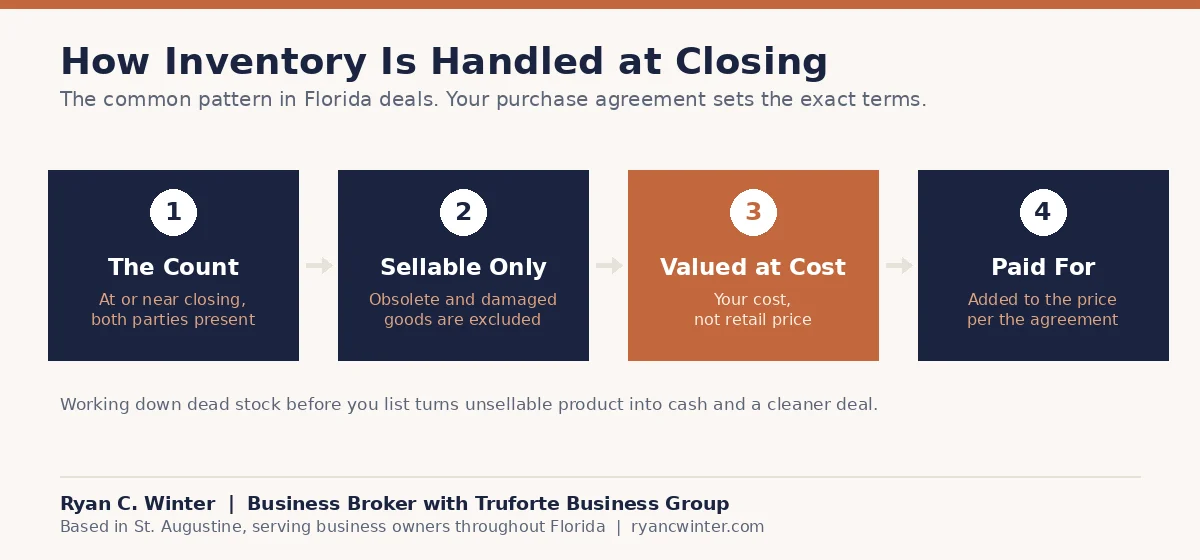
In many deals, the purchase price covers the business itself, and sellable inventory is bought in addition, at cost, based on an actual count taken at or near closing. The reason is fairness: inventory levels change every day, so pinning down an exact figure weeks in advance is impractical. Pricing it at cost, counted at closing, means the buyer pays for exactly what is on the shelves the day they take over.
You will see listings priced as the business plus inventory for exactly this reason. Neither side is guessing. The agreement sets the method, and the count sets the number.
The closing day count
Right before or on the day of closing, the inventory is counted, often with both parties present or a neutral inventory service handling it. For larger retail operations, hiring a professional counting service is common, and the cost of that service is frequently split between buyer and seller, though that too is negotiable and should be set in the agreement rather than argued about on closing day.
Only good, sellable inventory is usually counted. Obsolete, damaged, or expired goods are typically excluded, because a buyer should not pay full cost for product they cannot sell. Agreeing in advance on what counts as sellable avoids arguments during the count.
What “at cost” actually means
Cost means what you paid for the goods (your landed cost), not what you would sell them for. Expect the buyer to want support for that number: supplier invoices, your point-of-sale records, or your accounting system’s inventory valuation. If your recordkeeping on inventory is thin, tightening it up before you list is worth the effort, because a buyer who cannot verify cost will start discounting it.
Set expectations in the purchase agreement
Good purchase agreements address inventory clearly: how it will be valued, what will be included, and whether there is a target or cap on the amount. Some deals include a normal level of inventory in the price and only adjust if the count comes in above or below an agreed range. Spelling this out prevents a surprise five-figure bill landing on the buyer at the last minute, which can sour a deal.
Taxes, the allocation, and the lender
Two practical notes worth knowing. First, in an asset sale the purchase price, including inventory, gets allocated across asset classes on IRS Form 8594, and both sides file it; the purchase agreement normally fixes the allocation so the two filings match. Inventory is its own class, and how the allocation is drawn affects each side’s taxes, so involve your CPA before agreeing to it.
Second, when the buyer is financing with an SBA 7(a) loan, the lender is underwriting the whole transaction, inventory included. Clean inventory records make their job easier, and anything that makes the lender comfortable helps your closing timeline.
Clean it up before you sell
If you know you are heading toward a sale, this is a good reason to work down dead stock in advance. Carrying a lot of slow-moving or obsolete inventory does not help you, because a buyer will not pay for it. Selling through it beforehand turns it into cash for you and presents a leaner, healthier business to buyers.
Frequently asked questions
Is inventory included in the asking price of a business?
It depends on the listing. Many Florida listings are priced as the business plus inventory, with inventory bought at cost based on a closing count. Others include a normal inventory level in the price and adjust if the count differs. The listing and the purchase agreement should say which approach applies.
How is inventory valued when selling a business?
Typically at the seller’s cost, not retail price, supported by invoices or point-of-sale records, and limited to sellable goods. Obsolete, damaged, or expired stock is usually excluded or negotiated separately.
Who pays for the inventory count?
When a professional counting service is used, the cost is often split between buyer and seller, but this is negotiable. Set it in the purchase agreement in advance.
What happens to obsolete inventory in a business sale?
Buyers generally will not pay full cost for goods they cannot sell, so obsolete stock is excluded from the count, discounted, or kept by the seller. Working it down before listing usually puts more money in your pocket than negotiating over it at closing.
Does inventory work differently in a stock sale?
Yes. In a stock sale the company itself changes hands, so inventory simply stays inside the business rather than being bought separately. Most small Florida deals are asset sales, where the count and cost method described here is the common pattern. See asset sale versus stock sale for the difference.
Handle inventory the smart way
Inventory can be one of the smoother parts of a sale or one of the messier ones, depending on how it is set up. It is one piece of a larger process: see how to sell a business in Florida for the whole picture, and who keeps the accounts receivable for the other balance-sheet question sellers ask. I help sellers structure the count so it is fair, the terms are clear, and there are no closing-day surprises. The first conversation is free and completely confidential. Call me at (904) 789-1276 (Truforte Business Group) or reach out here.
Disclaimer: This article is general information, not legal, tax, accounting, or financial advice. I am a licensed business broker, not an attorney or accountant. Every business and every sale is different, and laws and tax rules change, so talk with a licensed attorney and a CPA about your situation before you act on anything here. SBA loan rules also change, so verify current requirements with the U.S. Small Business Administration or an SBA lender.