
How to Sell a Business in Florida: The Complete 2026 Owner’s Guide

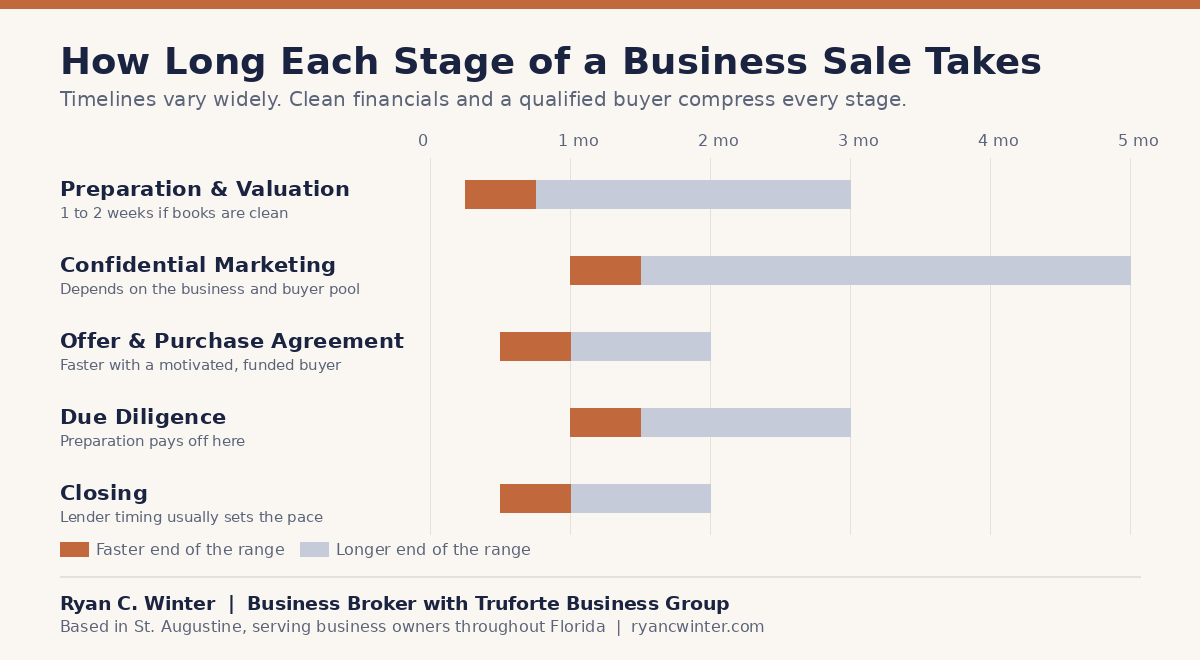
Short answer: To sell a business in Florida, you establish a defensible valuation based on your earnings, clean up your financials, market the business confidentially to qualified buyers, negotiate the offer (a purchase agreement with contingencies; some deals start with a letter of intent), complete due diligence, and close. Timelines vary widely. A well prepared business with a well qualified buyer can close quickly, while most main street businesses take six to twelve months from listing to closing.
I am Ryan C. Winter, a licensed Florida business broker with Truforte Business Group, based in St. Augustine and working with owners throughout Florida. This guide walks through how a Florida business sale actually happens, what it costs, how long it takes, and where deals fall apart. It is written for owners of privately held businesses, which is where most of my work sits.
The steps to sell a business in Florida, at a glance
- Get a realistic valuation. For most owner-run businesses it starts with seller’s discretionary earnings, adjusted for risk. My guide to what your Florida business is worth explains how.
- Clean up your financials. Reconcile three years of tax returns, profit and loss statements, and bank deposits so a buyer and a lender can follow them.
- Put your company records in order. Confirm the company is active on Sunbiz with its annual report filed, and check which licenses, permits, and lease terms can transfer to a buyer.
- Market the business confidentially. A blind listing, a signed non-disclosure agreement, and buyer qualification come before anyone sees your name or the Confidential Business Review.
- Negotiate the offer. A purchase agreement with contingencies (some deals start with a letter of intent) sets the price, terms, and conditions.
- Support due diligence. The buyer and any lender verify your records, revenue, contracts, and equipment.
- Settle Florida taxes. File your final sales tax and reemployment tax returns, and in an asset sale provide the buyer a certificate of compliance from the Florida Department of Revenue under section 213.758, Florida Statutes.
- Close and hand over. Closing usually includes a bill of sale, a lease assignment, and a non-compete, followed by a training period for the new owner.
Most main street businesses take six to twelve months from listing to closing. Each step is covered in detail below, and the Florida Seller’s Guide walks through the same path as a step-by-step checklist.
Not sure where your business stands? Take my free sale readiness quiz: ten questions, an instant score, and a list of what to fix first.
What selling a business in Florida actually involves
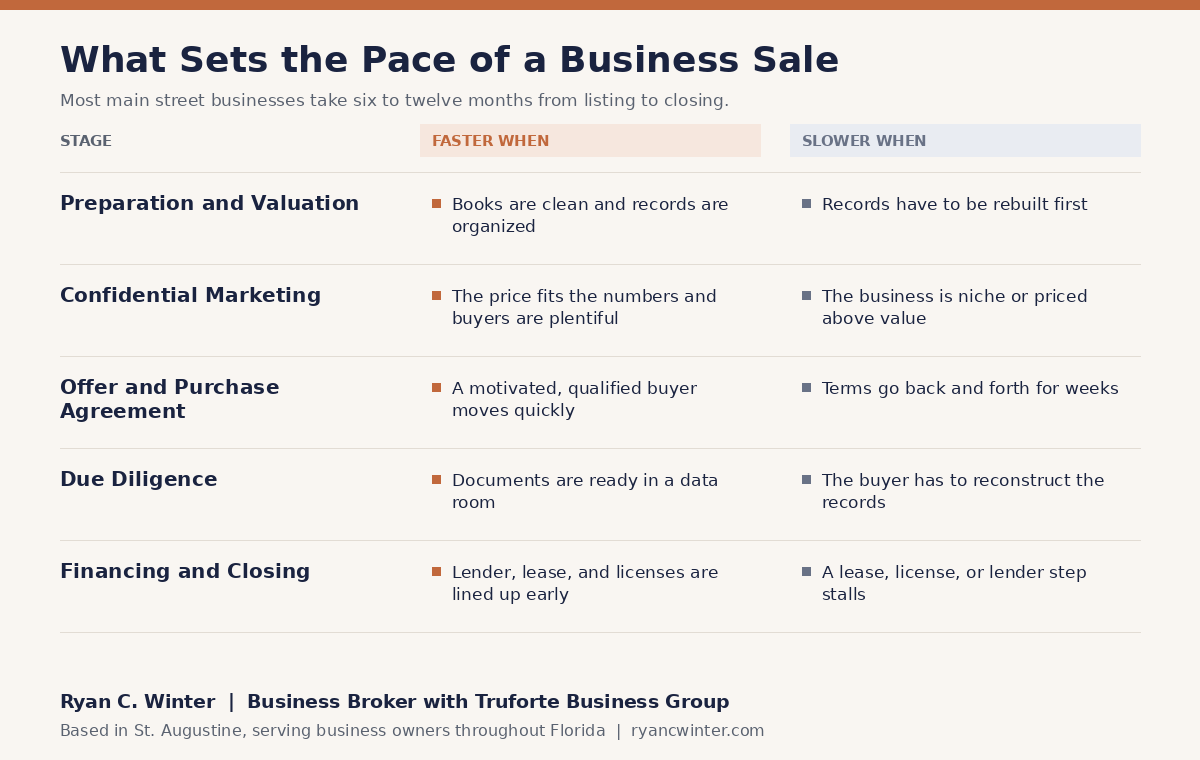
Selling a business is not one transaction. It is a sequence of stages, and each one can stall. Owners tend to underestimate the first stage and overestimate the last one. Preparation is where the money is made. Closing is mostly paperwork.
The honest answer on timing is that it depends on you. If your financials have been well maintained, preparation and valuation can move quickly rather than taking months, and a well prepared business in front of a well qualified buyer can move to closing fast. If the books need work, or the business leans heavily on you personally, the same sale can take far longer.
Find out what your business is actually worth
Smaller, owner operated businesses are usually valued on a multiple of seller’s discretionary earnings, or SDE. SDE is your net profit plus the owner’s salary, plus interest, taxes, depreciation and amortization, plus any personal or one time expenses running through the business. Larger businesses, where a buyer expects to hire a manager rather than step into your shoes, are more often valued on EBITDA. There is no bright line between the two. It depends on the size of the business, how it is structured, and who the likely buyer is.
The multiple applied to that number is where owners are most often surprised. Multiples vary considerably by industry, size, growth, and risk. Two businesses with identical earnings can be worth meaningfully different amounts. What moves the number is risk, not revenue, which is why rules of thumb are a poor substitute for understanding what a buyer is actually pricing.
What tends to raise your value
- Recurring or contracted revenue rather than one off jobs
- A team that runs the business without you in it every day
- Clean financials that reconcile to your tax returns
- A diversified customer base, where no single client represents an outsized share of revenue
- A transferable lease, licenses, and supplier relationships
What tends to lower it
- The business depends on you personally for sales or delivery
- Customer concentration, where losing one account would gut the business
- Cash sales that cannot be substantiated on the books
- Declining revenue over the trailing twelve months
- Deferred maintenance, aging equipment, or a lease about to expire
You can get a starting number in a few minutes with my free business valuation calculator. It is not a substitute for a broker opinion of value, but it will tell you whether your expectations are in the right neighborhood before you spend a year on this.
Clean up your financials before anyone asks
This is the highest return work you will do, and it is the stage that most affects your timeline. Buyers and their lenders will not take your word for anything. If your books do not reconcile to your tax returns, the deal either dies or reprices, and it usually reprices downward.
Practical steps: get three years of clean profit and loss statements and balance sheets. Separate personal expenses out of the business and document every add back you intend to claim. Reconcile your accounts monthly. If you are running personal vehicles, family phones, or a boat through the company, that is common in a small business, but every add back needs a receipt behind it.
Owners often ask whether a formal quality of earnings report is worth paying for. It depends on the size and complexity of the deal and on who the buyer is. On larger or more complex transactions it can pay for itself by removing the buyer’s excuse to renegotiate. On smaller, simpler deals, well organized statements and tax returns are frequently enough. It is a question worth asking early rather than in the middle of due diligence.
Market the business without destroying it
Confidentiality is not paranoia. If your employees learn the business is for sale, your best people start looking. If your competitors learn, they call your customers. If your customers learn, they hedge. A leak can cost you more than the broker fee.
The mechanics: the business is marketed under a blind profile that describes the operation and the market without naming it. Buyers sign a non-disclosure agreement and are qualified financially before they see anything identifying. Only then do they receive the Confidential Business Review (CBR) with the real numbers.
In Florida, Main Street listings are commonly marketed through the Business Brokers of Florida network alongside the national marketplaces. That combination is how you reach both in state buyers and the out of state buyers who move to Florida specifically to buy a business.
Owners also worry about staff. What happens to your employees is worth planning deliberately rather than improvising on closing day.
Buyers, offers, and how Florida deals get financed
Many Florida small business sales are financed with an SBA 7(a) loan. That matters more than owners expect, because it means the lender, not just the buyer, has to believe your numbers. SBA underwriting shapes the structure of the whole deal: the business has to cash flow the debt after paying the new owner a living wage.
For buyers using SBA financing, the lender sets the down payment, terms, and requirements within SBA rules. Seller financing is common in these deals and can help bridge the gap between what a buyer can fund and what you want at closing. Owners often resist carrying paper. In practice, a seller note is frequently what makes the price you wanted achievable, and it signals to the buyer that you believe the business will keep performing after you leave.
In my deals, offers usually go straight to a purchase agreement with contingencies, which sets price, terms, and deadlines in one binding document. Some deals start with a letter of intent instead. An LOI is mostly non binding on price but binding on exclusivity, which means the moment you sign it you have taken the business off the market for that buyer. Do not sign one casually.
Due diligence and closing
Due diligence is where prepared sellers get rewarded and unprepared sellers get repriced. The buyer verifies everything you claimed: financials, contracts, leases, licenses, equipment, litigation, and employees. This is the clearest example of preparation paying off. Sellers who did the work in Step 2 move through it quickly.
Two Florida specifics worth knowing. Small business sales here are commonly structured as asset sales rather than stock sales, which protects the buyer from historical liabilities and changes your tax treatment. The purchase price gets allocated across asset classes, and buyer and seller generally each report it on IRS Form 8594. When the purchase agreement sets the allocation in writing, both sides are bound by it. That allocation is negotiable and there is real money in it, so involve your CPA before you agree to it, not after.
Second, Florida has no personal income tax, though a corporation can owe Florida corporate income tax. Your gain is still subject to federal income tax, some of it possibly at ordinary rates depending on how the price is allocated, but an individual seller is not paying a state income tax layer on top the way a seller in New York or California would. If you are spreading payments over years, the installment sale rules in IRS Publication 537 govern how that income is recognized.
Florida legal and tax steps every seller should know
Most of a business sale works the same in any state. These are the Florida-specific items that catch owners off guard, usually late in due diligence when there is the least time to fix them. Your Florida attorney and CPA should confirm how each one applies to your sale; this is general information, not legal or tax advice.
Keep the company active on Sunbiz
Buyers, lenders, and closing attorneys check your company’s status with the Florida Division of Corporations at Sunbiz.org. File the annual report on time (it is due each year within the filing window the Division of Corporations sets) and make sure the officers, managers, and registered agent listed there are current. A company that has been administratively dissolved has to be reinstated before it can close, and that can cost you weeks.
Settle your Florida sales tax before closing
Under section 213.758 of the Florida Statutes, a buyer who acquires a business, or enough of its assets or stock of goods to fall under the statute, can be held liable for the seller’s unpaid Florida taxes. The buyer is protected if the seller provides a certificate of compliance from the Florida Department of Revenue showing returns are filed and taxes are paid, or if the buyer requests a Department audit that finds no liability. The seller must also file a final return and pay any tax due within the deadline the statute sets after the transfer. Expect the buyer’s attorney to ask for this, and start the request early.
Reemployment tax and payroll accounts
Your Florida reemployment tax account (the state unemployment tax, administered by the Department of Revenue) needs to be current. In many sales the buyer takes over the account’s history along with the employees, which affects the buyer’s future tax rate, so it comes up in negotiation. Have your CPA confirm how your particular structure is handled.
The non-compete you will be asked to sign
Almost every buyer will ask you not to compete with the business you just sold. Florida enforces reasonable non-competes under section 542.335, and when the restriction is tied to the sale of a business, the statute sets time periods that courts presume reasonable or unreasonable. Negotiate the geography and the duration, not just whether to sign one, and make sure it is in writing.
Licenses, permits, and your lease
Professional and contractor licenses belong to the individual who holds them and do not transfer with the business, so the buyer needs a plan to qualify. Local business tax receipts are reissued to the new owner, and liquor licenses transfer through the Florida Division of Alcoholic Beverages and Tobacco. Most leases require the landlord’s consent to assign, and buyers and SBA lenders want enough term remaining to cover the loan, so review the lease with your attorney before you go to market, and if you need more term, ask the landlord for a renewal rather than announcing a sale.
Liens, escrow, and the closing table
Buyers search the Florida Secured Transaction Registry for UCC filings against your business, so expect equipment loans and lines of credit to be paid off from the proceeds at closing. Florida business sales usually close through a closing attorney or escrow agent who holds the buyer’s deposit, collects the lender’s funds, pays off liens, and disburses what is left to you.
What it costs to sell a business in Florida
Most Florida business brokers are paid a success fee at closing, out of the proceeds. My own fee is a success fee paid at closing that varies with the size of the transaction, within a broad range of 8 to 15 percent, with no upfront fees. You will also pay your own CPA and attorney, and those are worth every dollar. I break the full picture down in what a business broker charges in Florida.
One thing worth knowing about Florida specifically: business brokers here are regulated under Chapter 475 of the Florida Statutes and must hold a real estate license issued by the Florida Department of Business and Professional Regulation. If someone offers to broker your business without one, that is a problem. You can verify any license on the DBPR website in a few minutes, including mine.
Do you actually need a broker?
Honestly, not always. If you already have a buyer, know your number, and have a good transaction attorney, you may not need me. Owners who sell to a family member, a partner, or a key employee often do fine without a broker, and I will tell you that on the phone rather than after you sign a listing agreement.
Where a broker earns the fee is in reach, confidentiality, buyer qualification, and keeping the deal alive through due diligence. Sales that fall apart usually do so after an offer is accepted, and they fall apart for emotional and procedural reasons more often than financial ones. That is most of what a broker actually does.
Selling guides by industry
Every industry sells a little differently: what buyers verify, how the business is priced, and which licenses or leases have to transfer. These guides go deeper on the specifics.
Trades and home services
- HVAC
- Plumbing
- Electrical Contracting
- Roofing
- Construction
- Flooring
- Painting
- Landscaping and Lawn Care
- Pool Service
- Pest Control
- Commercial Cleaning
Professional and licensed practices
- CPA Firm
- Law Firm
- Insurance Agency
- Real Estate Brokerage
- Mortgage Brokerage
- Medical and Healthcare
- Dental Practice
- Veterinary Practice
- Funeral Home
Food, retail, and hospitality
- Restaurant and Cafe
- Catering
- Liquor Store
- Gas Station and Convenience Store
- Retail
- Jewelry Store
- Hotel and Motel
- Laundromat
- Car Wash
Personal and Consumer Services
- Hair Salon and Barbershop
- Gym and Fitness Studio
- Daycare and Child Care
- Tutoring and Learning Center
- Photography
- Event Planning
Transportation, industrial, and technology
- Trucking and Logistics
- Moving Company
- Auto Repair
- Marine and Boat Repair
- Self-Storage
- Manufacturing
- Printing and Signs
- IT and Managed Services
- Marketing Agency
- E-commerce
- Home-Based and Online
Special situations
Frequently asked questions
How long does it take to sell a business in Florida?
It varies more than owners expect, and preparation is the biggest factor. A well prepared business with clean financials and a well qualified buyer can close quickly. Most main street businesses take six to twelve months from listing to closing. If your books are already well maintained, preparation and valuation can move fast rather than taking months, which compresses everything downstream.
What is my Florida business worth?
It depends on your earnings and, more importantly, on risk. Smaller owner operated businesses are usually priced on a multiple of seller’s discretionary earnings, while larger ones are more often priced on EBITDA. Multiples vary by industry, size, growth, and how dependent the business is on the owner. The free valuation calculator gives a starting estimate, and a broker opinion of value will refine it.
Do I have to pay Florida state tax when I sell my business?
Florida has no personal income tax, though a corporation can owe Florida corporate income tax. You will still owe federal capital gains tax, and how the purchase price is allocated across asset classes on IRS Form 8594 materially affects what you pay. Talk to your CPA before agreeing to an allocation.
Will the buyer be responsible for my unpaid Florida sales tax?
They can be. Under Florida law, a buyer who acquires a business, or enough of its assets to fall under the statute, can be held liable for the seller’s unpaid state taxes unless the seller provides a certificate of compliance from the Florida Department of Revenue, or the buyer obtains a Department audit showing nothing is owed. That is why buyers’ attorneys ask for it, and why sellers should request it early. You also have to file a final return and pay within the deadline the statute sets after the sale.
How much do I need to put down to buy a business with an SBA loan?
SBA 7(a) loans commonly finance acquisitions; the lender sets the down payment, terms, and requirements within SBA rules. Seller financing is common alongside it and can help bridge the gap between what the buyer can fund and what the seller wants at closing.
Will my employees find out I am selling?
Not if the sale is run properly. The business is marketed under a blind profile, buyers sign an NDA and are financially qualified before receiving identifying information, and staff are typically told at or near closing as part of a planned transition.
Do Florida business brokers need a license?
Yes. Business brokers in Florida are regulated under Chapter 475 of the Florida Statutes and must hold a real estate license issued by the Florida Department of Business and Professional Regulation. You can verify any broker’s license on the DBPR website.
Can I sell my business myself without a broker?
Yes, and it often makes sense when you already have a buyer, such as a family member, partner, or key employee. Without an identified buyer, the hard parts are reaching qualified buyers confidentially and holding the deal together through due diligence, which is where unrepresented sales most often fail.
Where to start
If you are well ahead of a sale, start with preparation. Clean the books, reduce how much the business depends on you, and lock down your lease. If you are closer than that, start with a valuation so you know whether your number is realistic.
You can work through the whole process in my complete seller’s guide, run your numbers with the valuation calculator, or reach out directly for a confidential conversation. I am based in St. Augustine and work with owners across Florida, and there is no cost to talk it through.
Sitting on the other side of the table? See how to buy a business in Florida.
Prefer video? You can watch the full walkthrough of how a business sale works.
Disclaimer: This article is general information, not legal, tax, accounting, or financial advice. I am a licensed business broker, not an attorney or accountant. Every business and every sale is different, and laws and tax rules change, so talk with a licensed attorney and a CPA about your situation before you act on anything here. SBA loan rules also change, so verify current requirements with the U.S. Small Business Administration or an SBA lender.