
What Multiple of Earnings Should I Sell My Business For?
 Ryan C. Winter Updated October 16, 2026

Short answer: Businesses sell for a multiple of their earnings, usually seller’s discretionary earnings for owner operated companies and EBITDA for larger ones. The multiple is not a fixed number. It moves with risk, size, industry, growth, and the quality of your books, which is why two businesses with identical profits can sell for very different prices.
When business owners ask “what is my business worth,” what they are really asking is: what multiple of my earnings will a buyer pay? I am a business broker based in St. Augustine working with owners throughout Florida, and the multiple conversation is where most sellers get their first surprise, in one direction or the other. Understanding what actually drives it gives you a roadmap for maximizing what you receive.
Prefer to watch? Here is the whole framework, SDE, multiples, and add-backs, in about five minutes:
What Is an Earnings Multiple?
A multiple is simply a number you multiply by your earnings to estimate value. Purely as arithmetic: a business generating $300,000 in seller’s discretionary earnings priced at three times SDE would be $900,000. At four times, $1.2 million. Same business, same profits, $300,000 apart, and the difference is entirely about how a buyer prices the risk of those earnings continuing after you leave.
Smaller, owner operated businesses are usually priced on SDE. Larger businesses, where a manager rather than the owner runs the day to day, are more often priced on EBITDA. There is no bright line between the two; it depends on the size and structure of the business and who the likely buyer is.
Why There Is No “Standard” Multiple
Owners often arrive with a number a friend or an article gave them. The honest answer is that multiples vary considerably, by industry, by size, by growth, and by risk, and the spread within a single industry can be as wide as the spread between industries. A rule of thumb is a starting point for a conversation, not a price.
Two patterns are worth knowing because they are directional and durable. First, larger businesses tend to command higher multiples than smaller ones, because they carry management teams, diversified customers, and systems that survive an ownership change. Second, businesses with recurring or contracted revenue tend to command higher multiples than businesses that resell their revenue from scratch every morning, which is why a service company with maintenance agreements is often prized over a walk-in retail operation with the same profit.
What Moves the Multiple
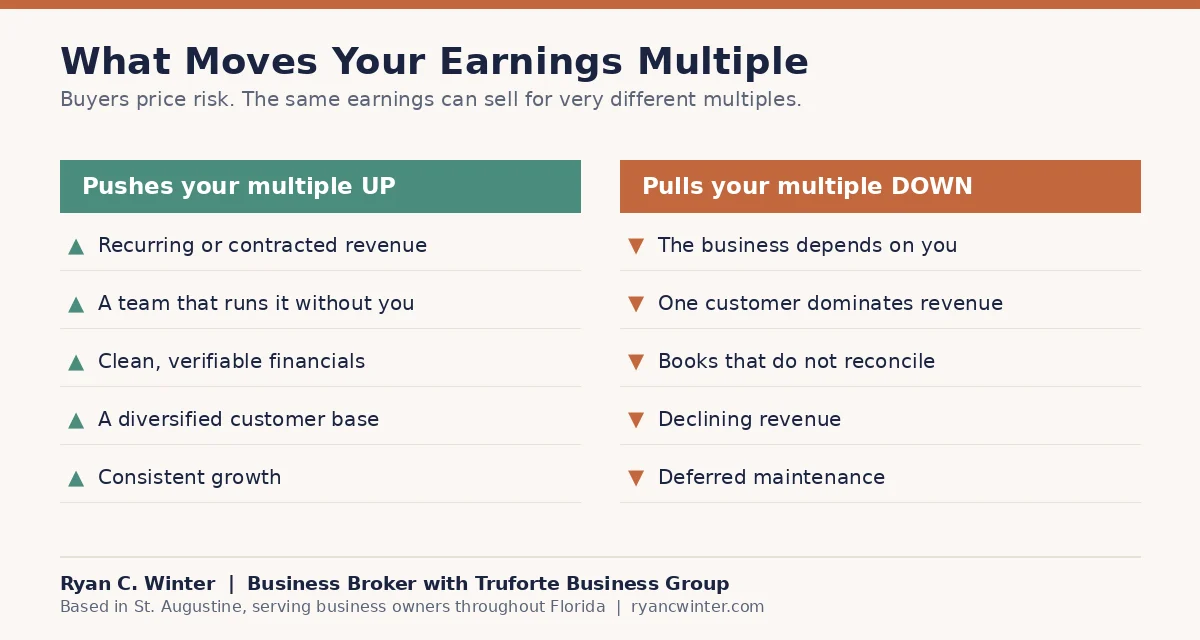
Buyers pay premium multiples for businesses that are low risk and high confidence:
- Recurring revenue. Contracts, subscriptions, or maintenance agreements that renew without being resold
- A diversified customer base. No single customer representing an outsized share of revenue
- Documented processes. Written procedures and trained staff that let the business run without the owner
- Growth. Consistent year over year revenue and earnings improvement
- Clean financials. Books that reconcile to tax returns and survive a lender’s scrutiny
- A team that stays. Key employees who will remain through the transition
What Compresses It
Owner dependency is the single biggest multiple killer. If the business cannot function without you, a buyer is buying a job, not an investment, and they will price it accordingly. Other compressors: customer concentration, undocumented financials, deferred maintenance, declining revenue, and unresolved legal or regulatory issues. Most of these are fixable, which is exactly why owners who prepare a year or two ahead of selling tend to do better than owners who list first and fix later.
So What Number Should You Use?
The defensible way to price a business is from evidence, not folklore: what comparable businesses have actually sold for, adjusted for the specific risk profile of yours. Brokers price from real transaction data through networks like the Business Brokers of Florida, where completed sales, not asking prices, show what buyers actually paid. You can get a grounded starting estimate in a few minutes with my free business valuation calculator, and a broker opinion of value will refine it against the market.
Frequently Asked Questions
What multiple of earnings do small businesses sell for?
There is no single answer, and be cautious of anyone who gives you one without seeing your books. Multiples vary by industry, size, growth, and risk, and the factors above move the number more than any rule of thumb. A valuation grounded in comparable sales is the reliable way to find yours.
Is the multiple applied to revenue or profit?
Profit. For most owner operated businesses that means seller’s discretionary earnings, which is net profit plus the owner’s salary and benefits plus one time and personal expenses. Revenue multiples exist in some industries but earnings drive Main Street pricing.
How do I increase my multiple before selling?
Reduce the business’s dependence on you, build recurring revenue, clean up the books, diversify the customer base, and document how the business runs. These changes take time, which is why the best exits are planned well in advance rather than decided in a month.
Does my asking multiple decide my final price?
No. The market decides. Overpricing does not raise the outcome, it lengthens the timeline and stales the listing, while accurate pricing tends to create competition among buyers.
Find Out Where Your Business Sits
I help Florida business owners identify the specific factors limiting their multiple and fix them before going to market. Start with the valuation calculator, see the complete guide to selling a business in Florida for the full process, or reach out for a confidential conversation about what your business is worth today.
Some businesses do not sell at all, and the reasons are usually fixable. See what makes a business unsellable.
Prefer video? You can watch the video version: SDE, multiples, and add-backs.

Curious What Your Business Is Worth?
Get a free, data-driven estimate in under 3 minutes, no obligation, completely confidential.