
What Is the Rule of Thumb for Valuing a Small Business?
 Ryan C. Winter Updated August 1, 2026
Short answer: Rules of thumb are industry shortcuts, rough multiples of revenue or earnings, and they are a starting point, not a valuation. They ignore the risk factors that move real prices: owner dependence, customer concentration, growth, and the quality of your books. Use them to orient yourself, then price from actual comparable sales.
Rules of Thumb for Small Business Valuation, and Why They’re Just a Starting Point
When business owners start thinking about what their company might be worth, “rules of thumb” are often the first framework they encounter. These are industry-specific shortcuts, quick multiples of revenue or earnings, that give a rough sense of value. They’re useful for a first estimate, but dangerous if used as the final answer. Here’s what you need to know.
Common Rules of Thumb by Business Type
Rules of thumb vary significantly by industry. Here are benchmarks for common business types in Northeast Florida:
- Restaurants/Food Service: 2x–3x SDE, or 25%–40% of annual revenue
- HVAC/Plumbing/Electrical: 3x–5x SDE for owner-operated; up to 6x EBITDA with recurring service contracts
- Dental/Medical Practices: 60%–80% of annual collections
- Pest Control: 12x–18x monthly recurring revenue, or 3x–5x SDE
- CPA/Accounting Firms: 0.9x–1.4x annual revenue (client base quality dependent)
- Auto Repair: 2x–3.5x SDE
- Retail: 1.5x–2.5x SDE plus inventory
- Landscaping: 2x–4x SDE for residential; higher for commercial contracts
Why Rules of Thumb Are Imprecise
Rules of thumb are derived from historical transaction averages, and averages hide enormous variation. Two businesses in the same industry with the same revenue can have dramatically different values based on: profitability margins, customer concentration, owner dependency, contract quality, growth trajectory, location, and the current M&A market. A pest control company with 90% customer retention and automated routes is worth far more than one with 60% churn and an owner doing daily service, even if their revenue is identical.
What Actually Determines Value
Professional business valuations use one or more of three standard approaches:
- Income approach: Capitalizing normalized earnings (SDE or EBITDA) at an appropriate multiple, the most common method for small businesses
- Market approach: Comparing to actual sale prices of similar businesses, where rules of thumb come from
- Asset approach: Valuing the underlying assets (equipment, inventory, real estate), used for asset-heavy businesses or liquidation scenarios
Start with the Rule of Thumb, Then Go Deeper
Rules of thumb are a reasonable starting point for a first conversation. But before making any decisions about timing, pricing, or deal structure, get a professional opinion. A qualified M&A advisor can tell you not just what your business is worth today, but what specific changes would increase its value before you go to market.
Get a Real Valuation from Ryan C. Winter
Ryan C. Winter provides business valuations for St. Augustine and Northeast Florida business owners considering a sale. Contact us for a confidential assessment of what your business is truly worth in today’s market.
Related Reading
- How to Increase the Value of Your Business Before You Sell
- How Do I Reduce Owner Dependency to Increase My Business Value?
- 7 Ways to Increase Your Business Value Before Selling in Northeast Florida
A rule-of-thumb valuation is only where selling begins. See the full process of selling a business in Florida.
Why the Shortcut Misses
A rule of thumb treats every business in an industry as identical. Buyers do not. Two companies with the same revenue can have wildly different earnings quality, and two with the same earnings can carry entirely different risk. The factors in the chart above are what an actual buyer prices, and none of them appear in a rule of thumb. That is why owners who price from folklore are so often surprised, in both directions, by real offers.
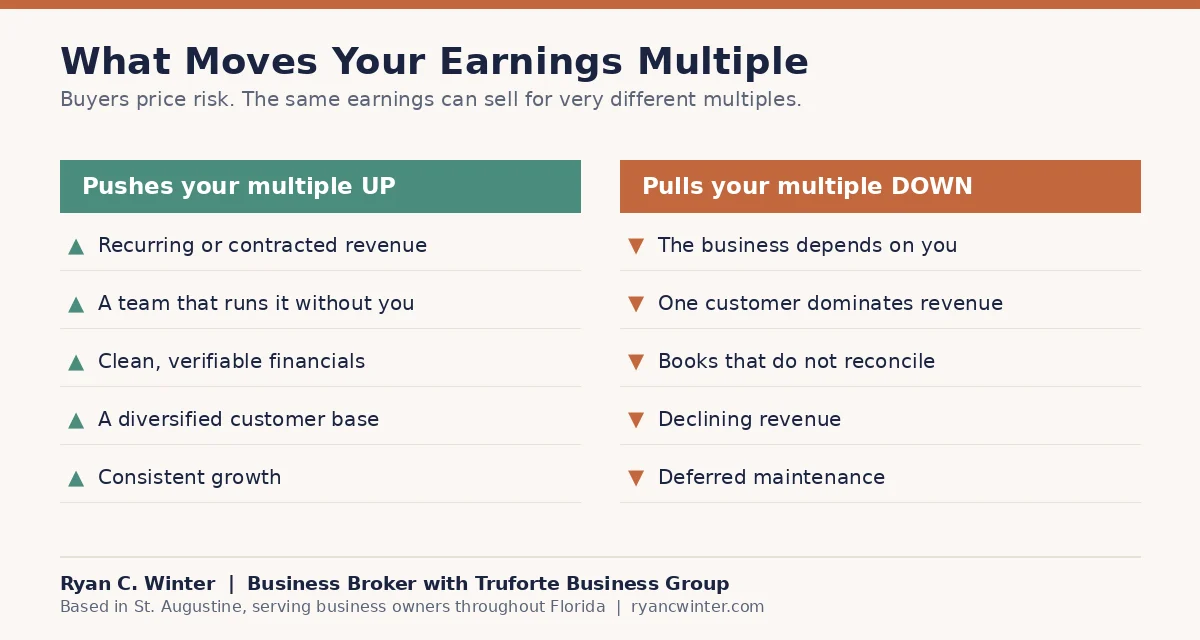
The better sequence: use the shortcut to orient yourself, then get grounded. Understand seller’s discretionary earnings, see what actually moves an earnings multiple, run the free valuation calculator for a starting estimate, and let comparable completed sales, not a formula from a book, set your expectations.
Frequently Asked Questions
What is the rule of thumb for valuing a small business?
Every industry has its own shortcuts, typically expressed as a multiple of annual earnings or revenue. They vary widely and ignore business-specific risk, so treat any single number as orientation, not an answer.
Are revenue multiples or earnings multiples better?
Earnings drive Main Street pricing, because buyers are buying profit, not activity. Revenue rules of thumb exist in some industries but routinely mislead owners whose margins differ from the industry average, which is most owners.
How do I get a real valuation instead?
Start with a calculator estimate based on your actual earnings, then get a broker opinion of value priced from comparable completed sales. See how to sell a business in Florida for where valuation fits in the process.

Curious What Your Business Is Worth?
Get a free, data-driven estimate in under 3 minutes, no obligation, completely confidential.