
What Is a Non-Disclosure Agreement When Selling a Business?
 Ryan C. Winter Updated August 9, 2026
Short answer: A non-disclosure agreement is the contract a potential buyer signs before you show them anything identifying about your business. It obligates them to keep your financials, customer information, and operations confidential, and not to use that information against you if the deal does not close.
Before you share anything sensitive with a potential buyer, they sign an NDA. It is one of the first documents in the sale process and one of the most important for protecting you. I am a business broker based in St. Augustine, and I work with owners throughout Florida. Here is how the NDA actually functions in a real sale, and what it does and does not do for you.
What Is an NDA?
A non-disclosure agreement, also called a confidentiality agreement or CA, is a legal contract that prevents a potential buyer from sharing your confidential business information with others, or using it against you if the deal falls through.
When you sell, you will share financial statements, customer lists, employee information, supplier terms, and operational details. That information is valuable, and it is potentially damaging in the wrong hands. Your competitor would like to see it. So would anyone thinking of starting a business like yours. The NDA creates a legal obligation for the buyer to protect it.
Where the NDA Sits in the Sale Process
The NDA is a gate, not a formality. It is signed before the buyer receives your confidential information memorandum or any detailed financials. Everything upstream of it is deliberately anonymous.
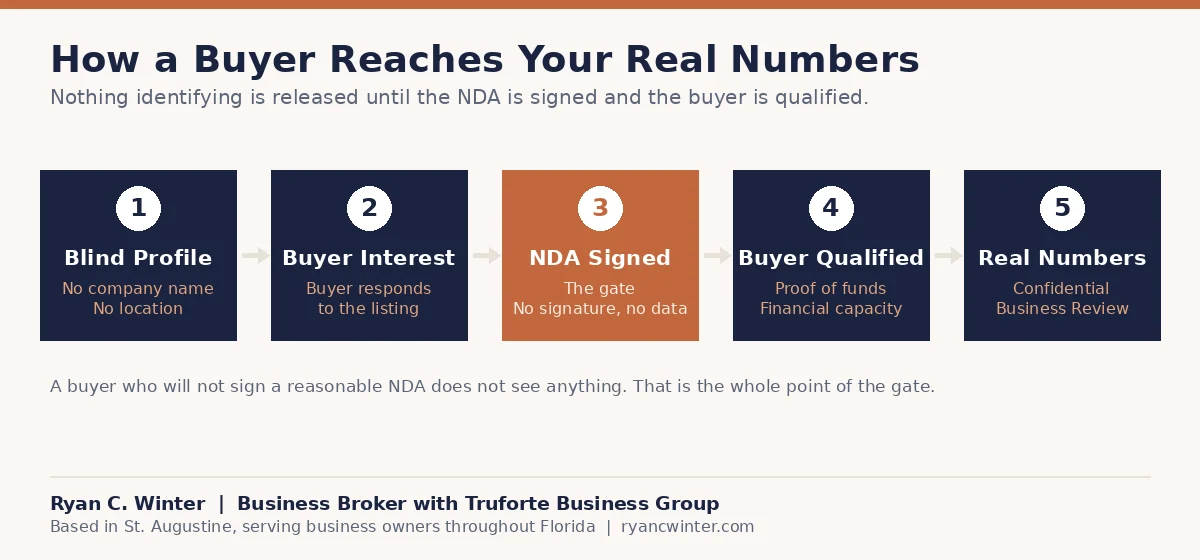
Notice what happens at step four. Signing the NDA alone is not enough to see your numbers. A signature costs a buyer nothing. Financial qualification is what separates a serious buyer from a curious one, and it happens before the real information is released. Keeping the sale confidential depends on both gates, not just the paperwork.
What Does a Business Sale NDA Typically Cover?
- Definition of confidential information. What is and is not protected, usually everything shared during the sale process
- Non-disclosure obligation. The buyer cannot share your information with third parties, with carve outs for their own advisors who are bound by the same obligation
- Non-solicitation. The buyer cannot recruit or poach your employees or customers
- Non-compete provisions. Sometimes included, to stop a buyer using what they learned to start a competing business if the deal dies
- Term. How long the obligation lasts. This is negotiable and varies by deal
- Return or destruction of information. What happens to your documents if the deal does not close
The non-solicitation clause is the one owners overlook and the one I would fight hardest for. A competitor who signs an NDA, walks your operation, and then hires your two best technicians has damaged you far more than a leaked profit and loss statement ever would.
Is an NDA Actually Enforceable?
Yes, when it is drafted properly. Florida also protects trade secrets independently of any contract you sign, under the Florida Uniform Trade Secrets Act, and there is a federal route as well through the Defend Trade Secrets Act. Your NDA sits on top of those protections rather than replacing them.
Here is the honest part. Enforcing an NDA means proving a breach and then paying a lawyer to pursue it. That is slow and expensive, and the damage is usually already done by the time you find out. So the real value of an NDA is more practical than legal. It sets professional expectations, it deters casual sharing, it makes a buyer think twice, and it gives you recourse if something goes badly wrong. Treat it as a deterrent and a filter, not as a guarantee.
A well drafted NDA also signals to the buyer that you are running a professional process. That matters more than people expect. Buyers behave differently when they can tell the seller has done this before.
What If a Buyer Refuses to Sign?
Walk away. A serious buyer understands why the NDA exists and signs it without drama. A buyer who refuses is telling you something: they are not serious, they do not respect the process, or they want your information more than they want your business.
There is a softer version worth watching for too. Some buyers will sign but push to strip out the non-solicitation clause, or shorten the term to something meaningless. Pay attention to what a buyer negotiates hardest. It usually tells you what they were planning to do.
Never share financials, customer lists, or operational detail with anyone who has not signed.
How a Business Broker Handles NDAs
When you work with a broker, the NDA is part of a managed process rather than a document you email around. Buyers are vetted, NDAs are collected before anything is released, and confidentiality holds through the marketing period. That protects you from employees, competitors, and customers learning the business is for sale before you are ready.
It also protects you from a subtler risk: releasing information to a buyer who was never going to close. Qualification is where that gets caught. This is a large part of what a broker actually does, and it happens before you ever see an offer.
Frequently Asked Questions
When does a buyer sign the NDA when selling a business?
Before they receive anything identifying. The sequence is: the buyer sees a blind profile with no company name or location, expresses interest, signs the NDA, gets qualified financially, and only then receives the confidential information memorandum with your real numbers.
Is an NDA enforceable in Florida?
Yes, when properly drafted. Florida also protects trade secrets separately under the Florida Uniform Trade Secrets Act, and federal protection exists under the Defend Trade Secrets Act. Enforcement means proving a breach and pursuing legal action, which is slow and costly, so an NDA is best understood as a deterrent and a filter rather than a guarantee.
What should a business sale NDA include?
A definition of confidential information, a non-disclosure obligation covering the buyer and their advisors, a non-solicitation clause protecting your employees and customers, a term, and a provision for returning or destroying your documents if the deal does not close. Non-compete provisions are sometimes added.
What if a buyer will not sign an NDA?
Do not share anything. A serious buyer signs a reasonable NDA without hesitation. Also watch buyers who sign but push hard to remove the non-solicitation clause, because what a buyer negotiates hardest often reveals their intent.
Does an NDA stop my employees from finding out I am selling?
Not by itself. The NDA binds buyers. Keeping the sale quiet from your team depends on the whole process being run confidentially: blind marketing, buyer qualification, and controlling who receives what and when. Staff are typically told at or near closing as part of a planned transition.
Is an NDA the same as a confidentiality agreement?
Yes. In a business sale the terms non-disclosure agreement, confidentiality agreement, and CA are used interchangeably for the same document.
Where This Fits
The NDA is one gate in a longer process. If you want the whole picture, start with how to sell a business in Florida, or work through my seller’s guide. If you want to know what your business might be worth before any of this begins, run the numbers with the free valuation calculator.
If you are selling a business anywhere in Florida and want to understand how a confidential sale process actually works, reach out. There is no cost to talk it through.
Before a buyer sees your real numbers they receive a summary document. See what the confidential business review contains.

Curious What Your Business Is Worth?
Get a free, data-driven estimate in under 3 minutes, no obligation, completely confidential.