✓ Licensed Business Broker · BK3362329 ✓ Member, IBBA & Business Brokers of Florida ✓ Based in St. Augustine · Serving All of Florida Since 2018 📞 904-789-1276

Ryan C. Winter

The Blog

Buying a Business

Resources for buyers looking to acquire a business in St. Augustine, Jacksonville, Clay County, Flagler County, and Northeast Florida. Covers due diligence, SBA financing, letter of intent, and deal negotiation.

How to Buy a Business in Florida: The Complete 2026 Buyer’s Guide

Short answer: To buy a business in Florida, you prepare your financials and financing first, search through brokers and listing networks, evaluate businesses under NDA, negotiate a letter of intent, verify everything in due diligence while your lender underwrites the deal, and close. Most buyers finance with an SBA 7(a) loan and put down around 10 percent.

Buying an existing business is one of the fastest ways to own cash flow instead of building it from zero: the customers, staff, and systems already exist. I am a business broker based in St. Augustine, and I work with buyers throughout Florida. This guide walks through how a purchase actually happens, where deals go wrong, and how prepared buyers win against competing offers.

The Path from Decision to Keys
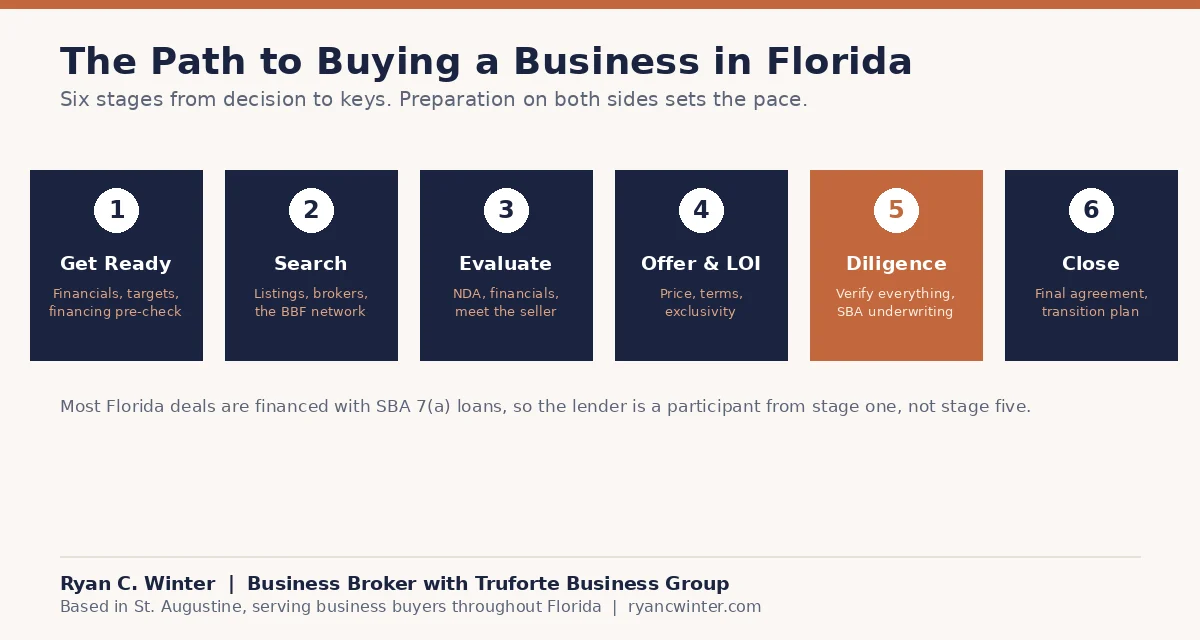
Six stage chart of buying a business in Florida: get ready, search, evaluate under NDA, offer and letter of intent, due diligence with SBA underwriting, and closing
Six stages from decision to keys. The buyers who move fastest did their preparation before they started shopping.

Step 1: Get Ready Before You Shop

The strongest buyers I work with decide three things before they look at a single listing. What they can afford, honestly, including working capital after closing, not just the purchase price. What they are actually suited to run, because industry experience matters less than buyers fear, but energy, hours, and customer-facing comfort matter more than they expect. And how they will finance it.

Financing deserves the head start. Most Florida small business purchases are financed with an SBA 7(a) loan, where buyers are typically expected to put down around 10 percent of the purchase price. Talking to an SBA lender before you shop tells you your real budget, and it makes your eventual offer dramatically more credible to sellers. It also helps you avoid the common reasons SBA acquisition loans get denied.

Step 2: Search Where the Businesses Actually Are

Public marketplaces like BizBuySell are worth watching, but in Florida a large share of deals trade through the Business Brokers of Florida MLS, a members-only network where brokers cooperate on each other’s listings. Working with a broker gets you into that flow, and it costs a buyer nothing: the seller pays the commission. Many of the best businesses also sell without ever being publicly listed, matched through brokers who know an owner is quietly ready. You can see current listings or tell me what you are looking for.

Step 3: Evaluate Under NDA

Serious evaluation starts after you sign a non-disclosure agreement and receive the confidential business review with real financials. Focus on three questions. Why is the owner selling, because retirement and burnout are normal, while selling ahead of a decline is what diligence exists to catch. Whether the earnings are real and verifiable against tax returns. And how dependent the business is on the current owner, because you are buying what remains after they leave. A first meeting with the seller tells you more than another week of spreadsheets; buyers who treat sellers as future partners rather than adversaries consistently get better deals. If you are new to this, start with what first-time buyers need to know and the red flags worth walking away from.

Step 4: The Offer and the LOI

Offers arrive as a letter of intent: price, structure, financing, and an exclusivity period for you to investigate. It is mostly non-binding on terms but it starts a clock, and what you do after signing the LOI decides whether the deal keeps its momentum. Deal structure matters as much as price. Many Florida deals include seller financing for part of the price, which bridges funding gaps and keeps the seller invested in your success through the transition.

Step 5: Due Diligence and Underwriting

Due diligence is where you verify everything: financials against tax returns, customer concentration, the lease and its assignment, licenses, equipment condition, and employees. Run it in parallel with your lender’s underwriting, not after it, because the SBA file is usually the critical path to closing. Two structural notes for Florida buyers: most small deals are asset purchases, which generally shields you from the seller’s pre-closing liabilities, and the price allocation both sides report on IRS Form 8594 affects your taxes for years, so involve your CPA before agreeing to it.

Step 6: Closing and Transition

The definitive purchase agreement replaces the LOI, the lease assigns, licenses transfer, and the money moves. Negotiate a real transition period: a seller who trains you, introduces customers, and hands over relationships is worth more than a few thousand dollars of price. Employees are typically told at or near closing, and keeping the team you just paid for is your first job as the new owner.

Frequently Asked Questions

How much money do I need to buy a business in Florida?

With SBA 7(a) financing, buyers typically put down around 10 percent of the purchase price, plus working capital to run the business after closing and professional fees for the deal itself. Seller financing can reduce the cash needed at closing.

Do I need industry experience to buy a business?

Often not. Lenders and sellers care about transferable management ability and financial capacity, and a good transition period covers the industry specifics. Highly licensed fields are the exception, where regulatory requirements apply.

How long does buying a business take?

From offer to closing, a well prepared deal with a responsive lender can close in a couple of months, and many run longer. The search itself is the variable: some buyers find the right business in weeks, others look for a year.

Does it cost anything to use a business broker as a buyer?

Typically no. The seller pays the commission at closing. A buyer working with a broker gets access to the listing networks, guidance through the process, and help holding the deal together, at no direct cost.

Should I buy an existing business or start one?

Buying gets you revenue, customers, staff, and financing eligibility from day one, at a price. Starting costs less up front and carries far more risk. Buyers who want cash flow now and can fund a down payment usually come out ahead buying established.

Start the Search

If you are selling rather than buying, start with how to sell a business in Florida. If you are buying, browse current businesses for sale, or reach out for a confidential conversation about what you are looking for. I am based in St. Augustine and work with buyers across Florida, and the first conversation costs nothing.
The Best SBA Lenders for Buying a Business in Florida (2026): An Honest Broker Review

Most business sales in Florida do not close with cash. They close with an SBA 7(a) loan, and that means the lender your buyer chooses can decide whether your deal closes in 60 days, drags for six months, or dies in underwriting. Yet almost nobody reviews SBA lenders the way they review everything else in a deal.

I’m Ryan C. Winter, a licensed business broker with Truforte Business Group, based in St. Augustine and working with buyers and sellers across Florida. I am not a lender, I do not get paid by any bank on this page, and I have no financing to sell you. What I have is a broker’s view of which lenders actually close business acquisition loans in Florida, drawn from published SBA lending data and the lenders’ own materials. If you are buying a business in Jacksonville, St. Augustine, or anywhere in the state, this is the review I wish existed when buyers ask me, as they always do, “who should I talk to about the loan?”

Why the Lender Matters as Much as the Rate

Business acquisition loans are the hardest kind of SBA lending because most of what you are buying is goodwill rather than hard collateral. Plenty of banks say they do SBA loans; far fewer are comfortable lending against cash flow on a business purchase. The ones that are share a few traits:

  • Preferred Lender Program (PLP) status, which lets the bank approve SBA loans in-house instead of waiting on the SBA, often saving weeks.
  • Real appetite for goodwill-heavy deals, proven by acquisition loan volume, not marketing pages.
  • Speed and deal literacy: underwriters who read a seller’s discretionary earnings statement without needing it explained.
  • Industry fit, since some lenders love restaurants and trades while others quietly avoid them.

In the SBA’s most recent fiscal year, acquisition lending nationally reached roughly $8.3 billion across about 7,000 deals, with an average loan around $1.2 million. Here is who is actually writing that volume, and who serves Florida buyers best.

The National Acquisition Specialists

Live Oak Bank

Live Oak is the largest SBA 7(a) lender in the country, with roughly $2.8 billion in approvals in the most recent fiscal year and, per published rankings, about 14 percent of all acquisition loan dollars nationally, more than any other bank. This is a branchless, industry-specialized lender that underwrites business purchases every single day, including in Florida. Strengths: deep acquisition experience, dedicated teams by industry, and comfort with goodwill-heavy deals that scare conventional banks. Trade-off: a national machine rather than a local banker you meet for coffee, and their volume means your file competes for attention. For deals above roughly $1 million, Live Oak should almost always be one of your quotes.

Newtek Bank

Newtek is the country’s second-largest SBA 7(a) lender at over $2 billion in recent annual approvals. Newtek runs a technology-driven, high-volume model and lends nationally, including Florida, across a wide range of deal sizes. Strengths: scale, speed on straightforward files, and willingness to look at deals other banks pass on. Trade-off: the experience is process-driven; buyers who want hand-holding sometimes find it impersonal. A strong second quote, especially for smaller acquisitions.

Huntington National Bank

Huntington ranks third nationally in SBA dollar volume and consistently first or near-first in the sheer number of SBA loans written, which tells you its machine is built for main street deal sizes. Its acquisition share, per published data, runs around 5 to 6 percent of loan count nationally. Strengths: process maturity and main street comfort. Trade-off: its branch footprint is Midwest-centered, so Florida borrowers typically work with its national SBA group remotely rather than a local banker.

The Florida and Northeast Florida Lenders

Ameris Bank

Ameris is a Southeast regional bank with a major Jacksonville presence and SBA Preferred Lender status, offering both 7(a) and 504 programs, and its own materials list buying another company as a core use case. For Northeast Florida buyers, Ameris offers something the national specialists cannot: a regional bank relationship you keep after closing, with branches where you can sit across from your banker. Strengths: PLP speed plus local presence, strong when real estate is part of the deal via 504. Trade-off: like most regional banks, appetite varies by industry and deal, so bring a well-packaged file.

VyStar Credit Union

VyStar is Jacksonville’s hometown credit union and one of the largest credit unions in Florida, with a business lending team serving Northeast Florida including St. Johns County. During the PPP era it ranked as the number one Florida credit union for small business relief lending, a fair signal of its commitment to local small business. For smaller acquisitions and buyers who value a true local relationship, VyStar is worth a conversation, and its non-real-estate loans under $75K are deliberately simple to apply for. Trade-off: credit unions generally write less acquisition volume than the SBA specialists, so pair a VyStar conversation with a national quote for comparison.

Quick Comparison

LenderTypeBest Fit for Florida BuyersWatch For
Live Oak BankNational SBA specialist, #1 by volumeAcquisitions $1M+, goodwill-heavy dealsNational process, no local branch
Newtek BankNational SBA specialist, #2 by volumeSmaller and harder-to-place dealsProcess-driven, less hand-holding
Huntington National BankNational bank, top-3 SBA volumeMain street deal sizesRemote relationship in Florida
Ameris BankSoutheast regional, PLPNE Florida buyers, deals with real estateAppetite varies by industry
VyStar Credit UnionJacksonville-based credit unionSmaller local deals, relationship bankingLower acquisition volume

Buying in Jacksonville or St. Augustine? Here Is How to Play It

My standing advice to Northeast Florida buyers is to get two quotes minimum: one national acquisition specialist and one lender with local presence. The specialist gives you certainty the deal type is financeable and a competitive benchmark; the local lender gives you speed on regional nuances, a banking relationship after closing, and sometimes surprising flexibility because they know the Jacksonville and St. Johns County market firsthand. Sellers should care about this too: when I represent a St. Augustine or Jacksonville listing, buyer financing is the single most common point of failure, and steering buyers toward proven acquisition lenders is part of protecting the deal. My guides on the SBA loan process in Northeast Florida, why SBA loans get denied, and how SBA financing affects a sale cover the mechanics.

Frequently Asked Questions

What is the best SBA lender for buying a business in Florida?

For most Florida acquisitions above $1 million, start with Live Oak Bank plus one regional option like Ameris. For smaller main street deals, add Newtek or Huntington and, in Northeast Florida, VyStar. The honest answer is that the best lender is the one whose underwriting appetite matches your specific deal, which is why two or three quotes beat any ranking, including this one.

How much down payment does an SBA acquisition loan require in Florida?

Plan on at least 10 percent of the project cost from the buyer, and many lenders like to see seller financing standing behind the deal as well. Stronger buyers and stronger businesses get better structures. Details in my Northeast Florida SBA guide.

Do local Jacksonville or St. Augustine banks do SBA business acquisition loans?

Yes. Ameris Bank has a significant Jacksonville presence with Preferred Lender status, and VyStar Credit Union is headquartered in Jacksonville and lends throughout Northeast Florida including St. Johns County. Local lenders are strongest on smaller deals and relationship banking; pair them with a national specialist quote for leverage.

Buying or Selling a Florida Business? Financing Is Half the Battle

I help buyers get connected with lenders who actually close Florida acquisition loans, and I help sellers prepare businesses so those lenders say yes. Either way, the conversation is free and confidential. Call (904) 789-1276 or start with the free valuation calculator.

Is It a Good Time to Buy a Business in Northeast Florida?

If you’re thinking about acquiring a business in Jacksonville, St. Augustine, or the surrounding Northeast Florida region, you’ve probably asked yourself: Is now actually a good time to do this?

It’s a smart question. The timing of a business acquisition, not just the business you’re buying, but when you buy it, can significantly affect your outcome. Here’s an honest look at the current landscape and what it means for prospective buyers in this market.

Northeast Florida: A Strong Foundation for Business Ownership

Let’s start with the regional fundamentals. Northeast Florida has a lot going for it as a business market:

Population growth: Jacksonville and the surrounding counties have been among the fastest-growing metropolitan areas in Florida, with consistent in-migration from higher-cost states. More people means more customers for local businesses across virtually every sector.

Business-friendly environment: Florida has no state income tax, a relatively low regulatory burden compared to many other states, and a pro-business political climate. These factors make it attractive for entrepreneurs and business owners.

Diverse economy: Northeast Florida’s economy spans healthcare, logistics and distribution (anchored by the Port of Jacksonville), military and defense, tourism (especially in St. Augustine), professional services, and a growing technology sector. That diversity provides stability, economic downturns that hurt one sector often leave others relatively unaffected.

Tourism: St. Augustine’s status as one of Florida’s top tourist destinations generates year-round customer traffic for restaurants, retail, hospitality, and service businesses that benefit from visitor spending alongside their local customer base.

Current Market Conditions for Business Buyers

The business acquisition market has its own dynamics separate from the stock market or general economic news. Here’s what buyers in Northeast Florida should know:

Seller inventory: There are consistently businesses for sale across all major categories in this market. The volume fluctuates, but established businesses change hands regularly in healthcare services, home services, food and beverage, professional services, and retail.

Baby boomer transition: A significant driver of business availability nationwide, and very much present in Northeast Florida, is the generational transition happening as baby boomer business owners reach retirement age. Many of them have built strong, profitable businesses and are now looking for the right buyer to carry things forward. This creates genuine opportunity for buyers who are ready to acquire and grow.

SBA financing availability: SBA 7(a) loans remain an important financing tool for business acquisitions, and lenders active in the Northeast Florida market continue to fund qualifying transactions. The cost of borrowing affects deal economics, but the availability of financing for well-priced, cash-flowing businesses has remained solid.

What to Look for Right Now

In the current environment, the businesses that make the most sense to acquire are those with:

  • Consistent, verifiable earnings over at least three years
  • A strong recurring revenue component or loyal customer base
  • Reasonable pricing relative to actual SDE or EBITDA
  • A viable lease with meaningful term remaining
  • A seller who’s willing to stay on for a proper transition
  • An industry with tailwinds rather than structural headwinds

Service businesses in the trades (HVAC, plumbing, electrical, landscaping) remain in high demand and can be strong acquisitions when priced appropriately. Healthcare services, including home health, physical therapy, and specialized medical practices, are another area of consistent buyer interest.

The Most Important Factor: You

Ultimately, the best time to buy a business isn’t determined solely by market conditions, it’s determined by your readiness. Do you have the financial capacity to make a down payment and keep reserves? Do you have relevant experience in the industry you’re entering? Are you ready to work hard, make decisions, and lead a team?

If the answer to those questions is yes, the Northeast Florida market has real opportunities for the right buyer.

Ready to Start Looking?

Whether you’re actively searching or just starting to explore what’s possible, a free consultation is the best way to understand what’s available in this market and whether it’s the right time for you specifically. Use our free business valuation calculator to evaluate businesses you’re considering, or reach out directly to start the conversation. We work with buyers and sellers throughout Northeast Florida and can help you find the right opportunity.

How to Finance a Business Acquisition in Florida

One of the biggest questions buyers face when considering a business acquisition is: How do I actually pay for this?

The good news is that you typically don’t need to have the full purchase price in cash. Most business acquisitions in Florida are financed through a combination of sources, and understanding your options helps you structure the deal in a way that works for your situation.

SBA 7(a) Loans: The Most Common Path

The Small Business Administration’s 7(a) loan program is the most widely used financing tool for business acquisitions in the U.S., and for good reason. SBA loans offer:

  • Up to $5 million in financing
  • Longer repayment terms (typically 10 years for business acquisitions)
  • Lower down payment requirements (usually 10–20% of the purchase price)
  • Competitive interest rates compared to conventional business loans

To qualify for an SBA loan, the business typically needs to demonstrate sufficient cash flow to service the debt after the buyer takes over. The buyer also needs to have reasonably good personal credit and some relevant experience. Lenders want to see that you can actually run what you’re buying.

The SBA process takes time, typically 45 to 90 days from the application to closing. Planning ahead and working with an SBA-preferred lender can speed things up significantly.

Seller Financing

In many Florida business transactions, sellers agree to finance a portion of the purchase price, meaning you make payments to them over time rather than paying everything at closing. This is called seller financing or a seller note.

Seller financing is extremely common for several reasons. It bridges the gap when a buyer can’t fund the entire purchase with an SBA loan or their own capital. It also signals confidence, a seller who is willing to get paid over time is telling you they believe the business will continue to perform well enough to make those payments.

Typical seller notes run 3 to 5 years at 5–8% interest. They’re often subordinate to an SBA loan, meaning the SBA lender gets paid first. The seller note portion might represent 10–20% of the purchase price.

Conventional Business Loans

Some buyers use conventional bank loans or credit union financing instead of SBA-backed loans. These are often faster to close but typically have stricter underwriting requirements, shorter repayment terms, and may require more collateral. For buyers with strong credit, significant assets, and a solid business case, conventional financing can be a good option.

Equity Investment and Partners

If the acquisition is larger than what you can finance personally and through an SBA loan, equity investment is another option. This might mean bringing in a silent partner, working with a search fund, or raising capital from investors in exchange for a share of the business.

This route is more complex and typically suited to businesses with higher earnings (usually $500,000+ in EBITDA) where institutional or angel investors see meaningful return potential.

Personal Assets and Retirement Funds

Some buyers use personal savings, investments, or home equity to fund part of their down payment. There’s also a legal structure called a ROBS (Rollover for Business Startups) that allows you to use funds from a 401(k) or IRA to buy a business without triggering early withdrawal penalties. ROBS strategies are complex and require specialized legal and tax advice to execute properly.

Putting It Together: A Typical Deal Structure

A common structure for a business acquisition in Florida might look like this:

  • 10–15% from the buyer as a down payment
  • 70–80% financed through an SBA 7(a) loan
  • 10–15% as a seller note paid over 3–5 years

Every deal is different, but this kind of structure makes it possible for qualified buyers to acquire a profitable business without needing to have millions in cash on hand.

Start With a Valuation

Before you can figure out how to finance a deal, you need to know what the business is actually worth, and whether the cash flow supports the financing structure you have in mind. Use our free business valuation calculator to run the numbers, or reach out for a free consultation to talk through your specific situation.

What Is Due Diligence When Buying a Business in Florida?

If you’re buying a business in Florida, you’ve probably heard the term due diligence, and if you’re a seller, you’re about to go through it. Either way, understanding what due diligence is, why it matters, and how to navigate it can make or break a business transaction.

What Is Due Diligence?

Due diligence is the process by which a buyer thoroughly investigates a business before finalizing a purchase. Once a Letter of Intent (LOI) is signed and the buyer and seller have agreed on basic terms, the buyer gets access to the business’s confidential information and has a set period, typically 30 to 60 days, to verify everything they were told about the business is accurate.

Think of it as the “trust but verify” phase of the transaction. The buyer is checking that the financials are accurate, the legal situation is clean, the operations are as described, and there are no hidden surprises that would change the value of the business.

What Buyers Look at During Due Diligence

A thorough due diligence review typically covers several key areas:

Financial due diligence: The buyer (and often a CPA) will review three years of tax returns, profit and loss statements, bank statements, and accounts receivable. They’re verifying that the revenue and earnings claimed in the marketing materials match what the records actually show.

Legal due diligence: This includes reviewing the business entity documents, any pending litigation, contracts with customers and vendors, intellectual property, and compliance with local, state, and federal regulations.

Operational due diligence: The buyer will want to understand how the business actually runs, your team, your processes, your supplier relationships, and what happens day-to-day. Some buyers will want to spend time in the business or speak with key employees (with the seller’s permission).

Lease and real estate review: If the business operates from a leased location, the buyer will review the lease terms, remaining term, renewal options, and whether the landlord will consent to an assignment.

Equipment and asset review: The buyer will want an accurate inventory of all equipment included in the sale, along with condition and maintenance history.

What Sellers Need to Have Ready

If you’re the seller, due diligence is smoother when you’re organized from the start. Documents you should have ready include:

  • Three years of business tax returns
  • Monthly profit and loss statements for the past three years
  • Year-to-date financials
  • Current balance sheet
  • Bank statements to verify deposits
  • A copy of your lease and any amendments
  • Equipment list and condition notes
  • Employee list with roles, tenure, and compensation
  • Key customer contracts or agreements
  • Any licenses, permits, or certifications required to operate

What Can Go Wrong During Due Diligence

Due diligence is where many deals fall apart. Common issues include financials that don’t match what was represented, unexpected legal liabilities, lease complications, key employee concerns, or environmental issues (especially in certain industries). The more transparent and organized a seller is, the less likely surprises are to derail the deal.

Buyers: don’t skip due diligence or rush through it to be nice. It’s your best protection against buying a business with hidden problems. Sellers: the best thing you can do is be honest, organized, and responsive.

Preparing for Due Diligence

Whether you’re a buyer or a seller, preparation is everything. If you’re a buyer looking at businesses in Florida, start by getting clear on what you need to verify. If you’re a seller, start cleaning up your records now, long before you go to market.

For a free consultation on buying or selling a business in Northeast Florida, or to get a quick estimate of a business’s value, use our free business valuation calculator and reach out anytime to discuss your specific situation.

Due diligence is one stage of the purchase. See where it fits in the full process of buying a business in Florida.

Cash Flow vs. Profit: What Business Buyers in Florida Really Care About

If you’re thinking about selling your business in Florida, you’ll quickly discover that buyers look at your finances very differently than you might expect. They’re not just interested in how much profit your business made last year. They’re focused on cash flow, and understanding the difference could help you present your business in a way that’s both accurate and compelling.

What Is Profit?

Profit is what’s left over from your revenue after you subtract your costs and expenses. It shows up on your income statement (also called your profit and loss statement). Net profit is the bottom line, the number most business owners point to when asked how well their business is doing.

But here’s the thing: profit as reported on your tax return often understates the real earning power of your business. Why? Because many business owners legitimately run personal expenses through the company, a vehicle, health insurance, a phone plan, certain meals and travel. These reduce your taxable income but don’t represent real costs to a buyer who would run the business differently.

What Is Cash Flow?

Cash flow is money actually moving in and out of your business. A business can be profitable on paper and still have serious cash flow problems if customers pay slowly, inventory sits on the shelf, or large expenses hit all at once.

Conversely, some businesses generate strong cash flow even when their reported profit looks modest, especially when the owner has been aggressive about taking tax deductions. This is why buyers and brokers typically don’t stop at net profit.

What Buyers Really Focus On: SDE

When evaluating a small to mid-sized business for acquisition, most buyers use a metric called Seller’s Discretionary Earnings, or SDE. This starts with your net profit and adds back all the expenses that were there for your benefit, your salary, personal expenses, depreciation, amortization, interest, and any one-time costs.

SDE represents the true cash benefit of owning and operating the business. It’s the number buyers use to calculate what the business is worth to them personally. And it’s almost always higher than the net profit on your tax return.

For example: if your business shows $50,000 in net profit, but you also paid yourself a $100,000 salary, ran $20,000 in personal expenses through the company, and had $15,000 in one-time equipment repairs, your SDE would be closer to $185,000. That’s a very different number.

Why Clean Books Matter

Buyers will want to verify your SDE number by going line by line through your financials. If your books are messy or your add-backs are hard to explain and document, buyers will discount your number or push for a lower price to compensate for the uncertainty.

One of the most effective things you can do before selling is to clean up your books and create a clear, well-documented add-back schedule that shows buyers exactly how to get from your reported net income to your true SDE. This is work that a good accountant or business broker can help you with.

Operating Cash Flow Also Matters

Beyond SDE, buyers pay attention to operating cash flow, specifically, whether the business generates enough cash to service any debt they take on to buy it. If you’re planning to offer seller financing, or if the buyer is getting an SBA loan, the lender and the buyer both need to see that the business cash flows comfortably after debt service.

This is another reason why strong, consistent earnings are critical. A business that generates $150,000 in SDE will support a much larger loan than one that generates $60,000, which means buyers can offer more and access better financing.

The Bottom Line

When it comes time to sell, the story your financials tell matters enormously. Buyers care about cash flow, specifically, what the business will actually put in their pocket after they take over. Getting clear on your SDE and presenting it well can have a material impact on both your sale price and the quality of buyers you attract.

Ready to get started? Use our free business valuation calculator to estimate what your business might be worth, or reach out for a free consultation and we’ll walk through your numbers together.

What Buyers Look for When Acquiring a Business in Northeast Florida

If you’re a business owner in Jacksonville, St. Augustine, or anywhere in Northeast Florida thinking about selling, understanding what buyers actually want can change the way you prepare, and significantly impact how much you get.

Buyers in this market are smart, motivated, and often have multiple options. Here’s what they’re really looking for when they evaluate a business acquisition.

Clean, Consistent Financial Performance

The single biggest thing buyers want is predictable earnings. They need to be able to look at your financials and say, “Yes, I can see myself making a living from this business.” That means consistent revenue over the past three years, healthy margins, and a clear story about where the money comes from.

Red flags include sharp revenue swings, unexplained dips, or financials that are hard to read because personal and business expenses are mixed together. If your books tell a confusing story, buyers will either lower their offer or walk away.

A Business That Can Run Without the Current Owner

This is the one thing most sellers don’t think about until it’s too late. If every key customer relationship, every supplier relationship, every operational decision runs through you personally, a buyer is going to be nervous. What happens when you leave?

Buyers want to see documented processes, trained employees, and a business that has operational momentum independent of the owner. This doesn’t mean you need to be completely hands-off today, but there should be a clear path for a new owner to step in and keep things running.

Growth Potential

Buyers aren’t just paying for the past, they’re paying for the future. They want to see opportunity on the horizon. Maybe there’s an underserved geographic area. Maybe there are services you haven’t had the bandwidth to offer. Maybe there’s a customer segment you’ve barely tapped.

When you talk to buyers, don’t just describe what the business is today. Help them see what it could become in the right hands.

A Solid Lease and Physical Location

For businesses that depend on a physical location, retail, restaurants, service businesses with showrooms, the lease is critical. Buyers want at least three to five years remaining on the lease, with renewal options. A short lease with an uncertain renewal is a deal-killer for many buyers because they’re taking on risk without security.

In the Northeast Florida market, where commercial real estate has been active and rents have shifted, this matters more than ever.

A Strong Team in Place

Buyers love walking into a business with experienced, loyal employees who know the operation. Staff turnover is expensive and disruptive, and buyers worry about key people leaving when ownership changes. If you have managers or senior employees who would stay through a sale, that’s a significant value add.

Consider having honest conversations with key team members about the possibility of a future sale, not necessarily with full details, but enough to know they’re open to working with new ownership.

A Reasonable Price

Buyers in Northeast Florida are experienced. They know the market, they’ve looked at comparable businesses, and they’ll spot an overpriced listing immediately. Overpricing your business doesn’t attract higher offers, it attracts fewer showings and longer time on market.

A realistic, well-supported asking price backed by solid financials will always outperform an inflated one over the long run.

Industry and Market Fit

Many buyers in the Jacksonville and St. Augustine markets are looking for specific industries, HVAC, plumbing, landscaping, healthcare services, professional services, food and beverage. Others are more flexible but want a business that fits their background and skills.

The right buyer for your business exists. Finding them is a matter of marketing, networking, and working with someone who knows where to look.

Thinking About Selling?

If you’re a Northeast Florida business owner wondering what your business is worth in today’s market, start with our free business valuation calculator for a quick estimate. Or contact us to schedule a free, no-obligation consultation. We’ll help you understand your options and put together a plan that works for you.

Why SBA Loans Get Denied for Business Acquisitions (and How to Avoid It)

SBA loans help thousands of people buy businesses every year, and for many Northeast Florida deals they are the financing that makes a sale possible. But not every application gets approved, and a denial late in the process can sink a deal you thought was done. If you are selling and your buyer is going the SBA route, it pays to know why these loans get denied and how to keep it from happening. Here are the common reasons.

The business cash flow does not support the loan

Lenders want to see that the business earns enough to comfortably cover the loan payments and still leave the new owner a living. If your financials do not clearly show sufficient cash flow, or if messy, unverifiable books make the lender nervous, the loan can be denied. This is one more reason clean, recast financials matter so much. If the numbers do not add up on paper, the deal struggles no matter how good the business is.

The buyer is not strong enough

The buyer has to qualify too. Weak credit, not enough of their own money to put down, or a lack of relevant experience can all lead to a denial. As a seller, you cannot control your buyer’s finances, but you can make sure, with my help, that you are dealing with a buyer who is genuinely qualified before you take your business off the market for them.

The valuation or price does not hold up

SBA lenders often require an independent business appraisal, and if that appraisal comes in below the agreed price, the loan may only cover the lower amount. That gap has to be bridged somehow, or the deal stalls. Pricing your business realistically from the start, based on a solid valuation, greatly reduces this risk. If you want a starting point, my free valuation calculator gives you a realistic range.

Lease or location problems

Lenders want location stability. If the lease term left is shorter than the loan, or the lease cannot be assigned to the buyer, the SBA loan can be held up until it is resolved. Sorting out your lease early, as I always recommend, keeps this from derailing a financed deal at the last minute.

Set your buyer up to succeed

A financed deal is a team effort, and preparation on the seller’s side makes approval far more likely. I help sellers price realistically, prepare strong financials, and work with lenders who know business acquisitions, so your buyer’s loan actually closes. The first conversation is free and completely confidential. Call me at (904) 789-1276 or reach out here.

Avoiding a loan denial is one part of preparation. See how to buy a business in Florida, start to finish.

Understanding Contingencies in a Business Purchase Offer

When a buyer makes an offer on your business, that offer almost always comes with conditions attached. These are called contingencies, and they are the things that must happen before the buyer is obligated to close. Understanding contingencies is important, because they determine how solid an offer really is and where a deal can fall apart. Here is what Northeast Florida sellers need to know.

What a contingency is

A contingency is a condition in the purchase agreement that lets the buyer back out, usually without penalty, if it is not met. Think of them as boxes that have to be checked between the signed offer and the final closing. Contingencies protect the buyer, but as the seller you need to understand them because each one is a point where the deal could end.

Common contingencies in a business sale

  • Due diligence. The buyer confirms the business is what you represented. This is the big one.
  • Financing. The deal depends on the buyer securing a loan, often SBA-backed.
  • Lease assignment. The landlord must agree to transfer the lease to the buyer.
  • Licensing or permits. The buyer must be able to obtain any licenses the business requires to operate.

Watch the timelines

Each contingency usually has a deadline. The buyer has a set window to complete due diligence, secure financing, and so on. These timelines keep the deal moving and protect you from a buyer who ties up your business indefinitely. When a contingency period passes without the buyer objecting, that condition is generally satisfied and the deal becomes more secure. Keeping these dates on track is a big part of managing a sale.

Fewer contingencies means a stronger offer

When you compare offers, the number and nature of contingencies tell you a lot about how firm each one is. An all-cash offer with limited contingencies carries more certainty than one loaded with conditions. That does not mean contingencies are bad, they are normal and expected, but understanding them helps you judge which buyer is most likely to actually close.

Navigate the conditions with confidence

Contingencies are where deals live or die, and managing them well is one of the most valuable things a broker does. I help sellers evaluate the conditions in an offer and shepherd each one to completion. The first conversation is free and completely confidential. Call me at (904) 789-1276 or reach out here.

Selling to a Private Equity Buyer vs an Individual: What Is the Difference?

Not all buyers are the same, and the kind of buyer you sell to shapes everything from your price to what happens to your team after closing. Two of the most common types are individual buyers and private equity buyers. If you own a business in Northeast Florida, understanding the difference helps you know what to expect and which buyer fits your goals.

The individual buyer

An individual buyer is usually a person purchasing a business to own and operate themselves, often with an SBA loan and their own savings. This is the most common buyer for small businesses. They tend to be hands-on and motivated to keep the business running well, because it becomes their livelihood. They may need more guidance through the process, and their purchase often depends on financing, which affects the timeline. For many owners, an individual buyer who will care for the business the way they did is exactly the right outcome.

The private equity buyer

A private equity buyer is a firm that acquires businesses as investments, often to grow them and sell them again later at a profit. They are professional buyers with capital and experience. They can move quickly, may pay well for the right business, and sometimes want the owner or team to stay on and keep running things. Private equity typically looks for businesses of a certain size and profitability, so not every small business is on their radar, but larger, well-run companies often are.

Key differences to weigh

  • Speed and certainty. Private equity buyers usually have funding ready. Individual buyers often rely on loan approval.
  • Your role after the sale. Individuals often want you out after a short transition. Private equity may want you to stay involved.
  • Deal complexity. Private equity deals can be more complex, with structures like partial rollovers where you keep a stake.

The right buyer depends on your goals

There is no universally better buyer. If a clean exit and continuity for your community matter most, an individual may be ideal. If speed, a higher price, or staying involved for another chapter appeal to you, a private equity buyer might be a better fit. Knowing what you want from the sale helps target the right audience from the start.

Let us find your right buyer

Part of my job is matching your business with the type of buyer that fits your goals and your business’s size and strength. I can help you understand who your likely buyers are and how to attract them. The first conversation is free and completely confidential. Call me at (904) 789-1276 or reach out here.